Showing posts with label 1939. Show all posts

Friday, November 24, 2006

Aaron's Magazine of the Week :: Startling Stories November 1939

Startling Stories November 1939Continuing our tribute to Jack Williamson (1908-2006), the Magazine of the Week is the November 1939 issue of Startling Stories, with cover story "The Fortress of Utopia" by Williamson, a story he remembered fondly in a
1999 Interzone interview.

I thought this magazine would be a fitting one to honor Jack Williamson, not only because I love the cover's science fictional variation on the story of Noah's Ark (even if it is not quite so garish a cover as last week's), but because the magazine contains a profile of Jack Williamson in which he boasts of recently passing one million words published in his career. There is no telling how many millions more words he wrote between then and his most recent novel, The Stonehenge Gate (2005).

From 1928 on, Jack Williamson was one of the regulars of the science fiction pulps until the market shifted to paperbacks. It is remarkable that he was then able to reinvent himself as a more sophisticated writer and continue his career for another half-century. Next week we will honor another mainstay of the science fiction pulps who recently passed away, a writer who was not inclined to make that transition after the pulp magazines disappeared and had written only sparingly since the 1950's.

Saturday, October 28, 2006

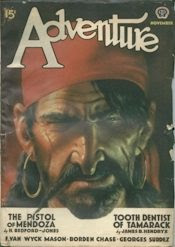
Aaron's Magazine of the Week :: Adventure November 1939

Adventure November 1939The Magazine of the Week is the November 1939 issue of Adventure magazine, cover art by Wesley Neff. Adventure was the flagship of the adventure genre of pulp magazines. Under the direction of editor Arthur Sullivant Hoffman and assistant editor Sinclair Lewis (who went on to be the first American to win the Nobel Prize for literature), Adventure became a huge success soon after its initial publication in 1910. This quickly gave rise to a great many competitors, such as Action Stories, Red Blooded Stories, Danger Trail, Dynamic Adventures, Thrilling Adventures, Mammoth Adventures, Dime Adventure, and the eloquently named Man Stories. Adventure pulps were as popular as any genre, yet unlike science fiction, mysteries, westerns, and romance, adventure fiction did not remain a separate publishing category when the industry shifted from pulps to paperbacks.

Adventure and its imitators brought the most exotic locations of the world into the homes of pre-TV Americans. The plots were typically outlandish, Indiana Jones-style swashbucklers, yet Adventure was notoriously meticulous about the accuracy of factual details. This is probably why the most successful pulp writer of all, Edgar Rice Burroughs, never appeared in Adventure magazine--Adventure readers could not forgive him for placing a tiger in Africa, where there are no tigers, in the first Tarzan book.

Adventure invited readers to send in questions and retained experts in every field to answer. As a result, the letters section of Adventure is one of the most striking features of any pulp magazine. The questions to the editors in the Magazine of the Week include: How do you remove gold flour from sand? (Answer: Amalgamate the gold by adding mercury to the pan.) Any advice for navigating the Linville Gorge? (A: See that your hobnails are sharp and tight.) What is the best wood for footing arrows? (A: Genuine South American beefwood; order it from C.H. Pearson & Son Hardwood in Brooklyn.) What language is spoken in southwestern Abyssinia? (A: Amharic is the official language but Galla, spoken by the Bantu tribes, most widely used.) What is the best agent for killing and preserving very large moths and butterflies? (A: Potassium cyanide; handle with care.)

Adventure magazine had a fervently loyal fan base. It was the first pulp magazine to encourage its readers to join fan organizations, a marketing device later used successfully by the science fiction pulps. One of the fan organizations promoted by Adventure was The Legion, whose officers included Adventure editor Hoffman and Theodore Roosevelt, a devoted reader of Adventure. When the United States entered World War I, the Legion gathered information as to its members' skills and forwarded it to the War Department, which used this information in forming certain regiments. After the War, Theodore Roosevelt and other veterans in The Legion renamed the group the American Legion, and it remains an important veterans' organization to this day.

The popularity of the adventure genre dipped by the late 1930's. Adventure managed to survive until 1971, but sadly only by converting to a "slick" format girlie magazine. Even though the Magazine of the Week is a bit after Adventure's pulp heyday, I love this issue for the rugged pirate cover (not to mention the story title "Tooth Dentist of Tamarack"). We'll see another evocative, albeit politically incorrect by modern standards, Adventure cover next week.

Monday, May 01, 2006

Aaron's Magazine of the Week :: Astounding Science Fiction July 1939

Astounding Science Fiction July 1939The Magazine of the Week is the July 1939 issue of Astounding Science Fiction. Created in 1930, Astounding was the third magazine to enter the science fiction market, and eventually proved the most successful and important. Retitled Analog in 1960, it continues to be the best-selling magazine of science fiction. Wander over to the magazine rack of any major bookstore and you will see the latest issue of Analog magazine, 76 years old and still going strong.

Astounding / Analog became the most important magazine in the field thanks to editor John W. Campbell, Jr., who single-handedly reshaped the genre of science fiction. The quality of writing in the early science fiction pulps was very poor. Like the other SF pulps of the time, between 1930 and 1938, Astounding was largely filled with amateurish work, virtually unreadable to anyone but adolescent boys. That changed after Campbell became Astounding's editor in 1938. (Before that, Campbell had been one of the few competent authors in the genre, best remembered for his classic "Who Goes There?", twice filmed as The Thing.) Campbell insisted on competent writing and believable science. Finding few writers in the field who could meet his standards, he set about molding a generation of new writers who could. Campbell discovered and/or heavily influenced nearly every important science fiction writer of the 1940's and 50's, including in particular Isaac Asimov, Robert A. Heinlein, and A.E. van Vogt. The era that Campbell ushered in is to this day referred to as the "Golden Age" of science fiction.

The Golden Age of science fiction unofficially began with the July 1939 issue of Astounding, our Magazine of the Week. This issue featured the first published story by A.E. van Vogt and the first story in Astounding by Isaac Asimov. The August issue then printed the first published story by Robert A. Heinlein, and the Golden Age was off and running. The van Vogt cover story for the July 1939 issue, "Black Destroyer," was the first of his tales of the crew of the starship Space Beagle, an important inspiration for Gene Roddenberry's creation of Star Trek, as well as the movie Alien (whose producers van Vogt sued for plagiarism). The July 1939 issue also included a story by C.L. Moore, an underappreciated Golden Age author and another of the earliest women to write science fiction.

Beginning in 1939, the Golden Age of science fiction saw dozens of new science fiction magazines come to press. It is sometimes said that before then, between 1926 and 1938, Amazing, Wonder, and Astounding were the only professional science fiction magazines in existence. This is untrue, as you will see next week.