Friday, August 03, 2012

Battle of the Books, Summer 2012, First Round :: Songs of the Earth by Elspeth Cooper vs. The Games by Ted Kosmatka


The third matchup of the Summer Bracket of the 2012 Battle of the Books pits Songs of the Earth by Elspeth Cooper against The Games by Ted Kosmatka. Per our contest rules, I have read the first 25 pages of both, and the winner will be the book I most want to continue reading.

Songs of the Earth: Tor Books hardcover, March 2012, 467 pages, cover illustration by JS Collaboration, Book One of The Wild Hunt. Elspeth Cooper is a UK writer. Songs of the Earth, her first novel, was originally published in Great Britain by Gollancz in 2011. The first 25 pages is conveniently exactly two chapters.

Gair, a novice Church knight who has been imprisoned for months, faces judgment from his Order. Alderan surreptitiously watches the proceedings. Gair is found guilty of witchcraft and the punishment is death by burning. But Gair is granted clemency by the Preceptor, to the protest of the Elder Goran, and his sentence is commuted to branding, excommunication, and banishment.

After his hand is branded, Gair was brought to an inn by Alderan. Gair doesn’t know the older man, and reluctantly accepts the needed help he offers. Alderan asks Gair how long he has been able to hear the music. Alderan knows the unspoken ways magic manifests itself in young people. Gair relates some of his own experiences. When Gair complains of an odd headache, Alderan suspects that a witchfinder is already on Gair’s trail.

The Games: Del Rey Books hardcover, March 2012, 356 pages, cover design and illustration by David Stevenson based on a photograph copyright Reichelt R./plainpicture/Corbis. Ted Kosmatka is a US writer. The Games is his first novel. Kosmatka’s short fiction has been nominated for the Nebula Award and Theodore Sturgeon Memorial Award. The first 25 pages covers a prologue and almost all of chapter one.

In the prologue, a boy, Evan Chandler, is tested by doctors and men in suits. A teacher working with Evan was seriously hurt. Evan has neurological abnormalities, an odd mix of gifts and disabilities. Evan is taken away from his mother to apparently be a research subject.

In chapter one, Dr. Silas Williams, head of Olympic Development, attends the laboratory birth of a genetically engineered creature, a future gladiator. The USA has won the last three gold medals awarded in the gladiator completion, a fight to the death event where the only rule is no human DNA. Silas designed the previous winners, but under pressure to win, the commission this time chose a disturbing design by the unseen Evan Chandler. The appearance of the newborn creature shocks even its developers.

The Battle: These are two very different books: a medieval-like high fantasy with witchcraft and a near-future science fiction thriller with genetic engineering. Both are first novels. Both appear to involve questions about the ethics of the book’s fantastic element, although perhaps in differing degrees.

In Songs of the Earth, witchcraft is condemned by the religion of the Goddess. What’s unusual is that the accused witch, Gair, is also quite religious. As many fantasy protagonists, Gair has no family. He’s a likable enough character and seems honorable. Magic is interestingly portrayed as a natural development, at least for a few people, needing to be controlled, instead of something painstakingly learned from arcane books.

The Games seems to be heading towards scientists unwisely creating something monstrous. There’s antagonism and competition between the various scientists and administrators. Genetically designed Teddy pets and renewable marriage contracts make the setting not exactly like today. The writing in The Games is tighter, angrier, but I haven’t yet been pulled emotionally into the story.

It’s hard to say which book will ultimately be more entertaining after reading a mere 25 pages. But I’d rather read more about the witch escaping the witchfinder than about the gladiator beast.

THE WINNER: SONGS OF THE EARTH by Elspeth Cooper

Songs of the Earth will advance to meet either Hunter and Fox by Philippa Ballantine or Taft 2012 by Jason Heller in the second round.

To see the whole bracket, click here.

Sunday, July 29, 2012

Battle of the Books, Summer 2012, First Round :: Fair Coin by E.C. Myers vs. The Coldest War by Ian Tregillis


The second matchup of the Summer Bracket of the 2012 Battle of the Books has Fair Coin by E.C. Myers going against The Coldest War by Ian Tregillis. Per our contest rules, I have read the first 25 pages of both, and the winner will be the book I most want to continue reading.

Fair Coin: Pyr Books, April 2012, 285 pages, cover illustration by Sam Weber. Fair Coin is a YA contemporary fantasy set in the Eastern USA. Fair Coin is Myers' first novel. The first 25 pages cover a little more than three chapters.

Teenager Ephraim Scott comes home to find his mother passed out from vodka and pills. He calls 911. She thought Ephraim was dead, hit by a bus. The boy that died had Ephraim’s lost library card in his wallet.

At the hospital, Ephraim finds a plastic bag containing the dead boy’s stuff. The wallet, keys, and watch seem oddly similar to Ephraim’s, but there are some peculiar items, including a US commemorative quarter minted in the wrong year.

The next morning Ephraim goes straight from the hospital to his high school. The girl Ephraim has a crush on, Jena, spooks Ephraim by returning his library card. Now he has two identical library cards. Ephraim finds a note that appears to be in his best friend Nathan’s handwriting, although Nathan says he didn’t write it. The note reads “Make a wish and flip the coin to make it come true”. Ephraim flips the odd commemorative quarter and wishes his mom wasn’t in the hospital. Later, when Ephraim goes to the hospital, his mom isn’t there, and she wasn’t there last night either. It seems that Ephraim’s wish changed reality.

The Coldest War: Tor Books, July 2012, 251 pages, volume two of The Milkwood Triptych, cover art by Chris McGrath. The Coldest War is a fantasy / alternate history book. It’s the sequel to Bitter Seeds, which I haven’t read. The setting is a 1963 in which the Soviets control the European continent. Apparently WWII was fought secretly by British warlocks and a small group of Nazis with superhuman abilities powered by special batteries. The first 25 pages contain a prologue and about half of chapter one.

The prologue contains two incidents in England. In the first, a man, who I guess is a Soviet agent, pays a deadly visit on an elderly British warlock. In the other, a junkman, who is a German secretly living in Britain, is trying to reverse engineer a battery to allow him to access his former superhuman abilities.

In the first section of chapter one, Germans Gretel and Klaus are in a Russian gulag. They stole one of the batteries confiscated by the Russians at the end of WWII. Both Gretel and Klaus can use the Götterelektron and learned the Willenskräfte. Klaus uses the battery to dematerialize. Gretel can somehow see the future and plan accordingly. When the prison guards are drunk on homemade vodka, they make their escape. They hope to make it to the Paris Wall.

In the second partial section of chapter one, Lord William Beauclerk (Will) and his wife Gwendolyn are having dinner in London with his older brother, Aubrey, the Duke of Aelred and his Aubrey’s wife Viola. Apparently Will is haunted by classified things he did during the war. There was a Great European Famine of ’42 which was secretly caused by British Warlocks.

The Battle: The Coldest War is set in an alternate world. In Fair Coin alternate universes seem involved. Weirdly, someone getting drunk on vodka plays a part in both books.

I’d be happy to continue reading either of these books. Both are readable and interesting. Unfortunately, Battle of the Books forces me to chose only one.

In my opinion, Fair Coin accomplishes more in character development. I can feel for the characters emotionally. Ephraim is a likeable teenager. There are several nice SF references in Fair Coin, such as Ephraim finding in the dead boy’s wallet a ticket stub for the movie Neuromancer. I’m interested in where the story will go.

On the other hand, I think that The Coldest War is better, more sharply, written. The scenes contain memorable, sometimes creepy, details. But I don’t feel I know the characters quite yet. There’s a load of information, and a feeling of stepping into the middle of a story, as this is book two in a series. I assume there’ll be some Cold War-like conflict.

This is a very close book battle, and my decision could have easily gone either way. My verdict came down to: What haven’t I seen before? Even though I love the concept of alternate realities, where Fair Coin seems to be heading, I’ve read a variety of such tales. The same goes for magical wishes. Superhumans powered by batteries, that to me seems strange and different.

THE WINNER: THE COLDEST WAR by Ian Tregillis

The Coldest War will advance to meet Faith by John Love in the second round.

To see the whole bracket, click here.

Saturday, July 28, 2012

Aaron's Take on the 2012 Hugo Nominees :: NOVELETTES

To my tastes, the novelette category consists of four good stories and one great one.

Starting with the good, Paul Cornell's "The Copenhagen Interpretation" is a fun romp through a distinctive alternate history with some interesting speculations. It's the same setting as his prior Hugo nominee "One of Our Bastards Is Missing." Neither story struck me as having the depth I look for in a Hugo winner, but it also doesn't strike me that Cornell was shooting for that. He was just telling an entertaining story, and I can hardly blame him if people responded well enough to put it on the Hugo ballot.

Geoff Ryman's "What We Found" and Rachel Swirsky's "Fields of Gold" each ran into the same unfair problem——the authors have set my expectations unreasonably high. "What We Found" and "Fields of Gold" are both very nicely written, but I couldn't help feeling disappointed that they weren't quite so amazing as "Pol Pot's Beautiful Daughter" or "The Lady Who Plucked Red Flowers Beneath the Queen's Window." Serves them both right for being so bloody good.

"Six Months, Three Days" by Charlie Jane Anders is a very clever piece. I love the interplay between the two main characters, with their two opposing forms of clairvoyance. Even if the romance aspect of the tale didn't pull me in quite as much as I might have liked, it's still a memorable story.

My hands-down choice for best novelette of 2011 (from the day I first read it) is "Ray of Light" by Brad R. Torgersen. (And I'm not saying that just because Brad was so nice to all us new Writers of the Future kids last year.) "Ray of Light" is an engaging story with an emotionally charged ending. At the same time, it's a wonderful counterpoint to the dismal tone of so much of the current science fiction and fantasy field. Brad takes a bleak premise and turns it into an uplifting reading experience. Great work!

Aaron's Ballot for Best Novelette
1. Brad R. Torgersen - Ray of Light
2. Charlie Jane Anders - Six Months, Three Days
3. Rachel Swirsky - Fields of Gold
4. Geoff Ryman - What We Found
5. Paul Cornell - The Copenhagen Interpretation

Tuesday, July 24, 2012

Battle of the Books, Summer 2012, First Round :: Faith by John Love vs. My Vacation in Hell by Gene Twaronite


The first matchup of the Summer Bracket of the 2012 Battle of the Books pits Faith by John Love against My Vacation in Hell by Gene Twaronite. Per our contest rules, I have read the first 25 pages of both, and the winner will be the book I most want to continue reading.

Faith: Night Shade Books trade paperback, January 2012, 373 pages, cover art by Adam Paquette. John Love is a new British author. Faith, his first novel, is a science fiction space opera. The first 25 pages features two encounters with the mysterious spaceship called Faith.

After a patrolling warship is destroyed by the ship Faith, Weapons Officer Sarabt, a Sakhran, an alien humanoid with claws, is the sole survivor of a crashed lifeboat on the desert planet of Bast 3. He is mortally wounded and pregnant. Yes, he not she. He hopes to communicate the need to stop Faith to his fellow Sakhran officer on the Commonwealth's Outsider class ship Charles Manson. Hundreds of years earlier Faith devastated Sakhran space.

Elsewhere, in another solar system, there are malfunctions in the remote guidance of a long convoy of space freighters approaching the moon of Anubis 4. Captain Copeland of the Wulf, who is escorting the convoy, rightly fears the ship Faith is causing the malfunctions. Copeland is forced to vaporize some of the unmanned freighters he's escorting to prevent a crashlanding.

My Vacation in Hell: self-published, February 2012, 187 pages, cover design by Abigail Westbrook based on 1861 engraving “Lucifer, King of Hell” by Gustave Dore. My Vacation in Hell is a darkly humorous young adult fantasy. It’s a sequel to Gene Twaronite’s earlier middle grade novel, The Family That Wasn't. The first 25 pages cover a little more than four chapters.

My Vacation in Hell begins with a short future chapter, a teaser, in Hell. The teenage protagonist, John Bazukas-O'Reilly-Geronimo-Giovanni-Li Choy-Echeverria, called by an acronym of his last name, John Boggle, did a book report on Dante's Inferno. Via a daydream, John takes his own a trip to hell. The scenery of hell is modernized. A subway-like station leads to a misty endless plain. The gate to hell is a down elevator where he meets his best friend and guide, not coincidentally, named Virgil. When I stopped reading, John and Virgil were traveling in hell on a Harley-Davidson motorcycle with a sidecar.

A serious, somewhat disturbing, topic is included in My Vacation in Hell. When considering the people whom he’d put in hell, John Boggle mentions that "Uncle" Vinnie sexually abused him.

The Battle: Faith is a gritty, somewhat brutal, space opera in other solar systems. My Vacation in Hell is a chatty, sometimes humorously quirky fantasy set in the 1960s.

In Faith, the first two chapters are merely prefaces to the main story. There's blood and death, plus things are blown up. The setting is futuristic, with spaceships and aliens, but I have no idea of when or where. No flashy new technology has been introduced. There's a definite feel of threat from the ship Faith.

My Vacation in Hell seems like a stroll to Hell. The first person narrator, John Boggle, talks about this and that, offering up his opinions. There are some interesting sights in Hell, but there’s not much character interaction, and, so far, little sense of danger or urgency.

In my opinion, the characters and their emotions feel more real in Faith than in My Vacation in Hell. Although I hope that John Boggle will resolve his abuse issues, I'd rather read about those who will fight against the seemingly invincible ship Faith.

THE WINNER: FAITH by John Love

Faith will advance to meet either Fair Coin by E.C. Myers or The Coldest War by Ian Tregillis in the second round.

To see the whole bracket, click here.

Monday, July 23, 2012

Aaron's Take on the 2012 Hugo Nominees :: SHORT STORIES

Kudos to the folks nominating for the Hugo Awards this year. All of this year's Hugo-nominated short stories are well written, and the nominees include my two favorite short stories of 2011, either of which would be a most deserving winner.

Working my way up, "The Cartographer Wasps and the Anarchist Bees" by E. Lily Yu features some beautifully constructed sentences, which are especially impressive from such a young author. But I confess I reached the end without understanding the point of the exercise. The fault may be mine as a reader, but people who nominated this piece for the Hugo plainly got something out of it that I missed.

John Scalzi's "The Shadow War of the Night Dragons: Book One: The Dead City: Prologue" is a very funny parody (and I believe Scalzi ties Connie Willis for most colons in a Hugo-nominated title). I particularly love the first three sentences. I don't begrudge the story's nomination—it's not easy to write something this funny—but to me there's not enough substance for this one to win the award.

"The Homecoming" by Mike Resnick is a strong tale of a father's reunion with his son, who is estranged in more than one sense. The father-son dynamic put me strongly in mind of Resnick's story "One Perfect Morning, with Jackals," which received a well-deserved Hugo nomination in 1991.

That brings us to my two favorite short stories of 2011, and I'd be happy if they tied and both won the award. Forced to pick one, I'm going to make Ken Liu's "The Paper Menagerie" my #2 choice. The story is simple yet moving, presenting basic themes—an immigrant's alienation; how children often don't appreciate their parents until they're gone—in an original and powerful way. Great work by a fellow Writers of the Future winner.

My personal favorite short story of 2011 (and it was from the time it first came out) is "Movement" by Nancy Fulda. Like "The Paper Menagerie," this is a powerful and moving tale, with the added element that it successfully tells the story from a nearly-alien point of view. Most impressively, Fulda uses her protagonist's condition to craft the story's sad and poignant ending. This is a unique and outstanding piece.

Aaron's Ballot for Best Short Story
1. Nancy Fulda - Movement
2. Ken Liu - The Paper Menagerie
3. Mike Resnick - The Homecoming
4. John Scalzi - Shadow War of the Night Dragons: Book One: The Dead City: Prologue
5. E. Lily Yu - The Cartographer Wasps and the Anarchist Bees

Tuesday, July 17, 2012

Battle of the Books, Summer 2012 Bracket

battle books
James Renner's The Man from Primrose Lane is in the record books as our Spring 2012 champion, but the review copies keep pouring in, so . . .


Welcome to the Summer 2012 Fantastic Reviews Battle of the Books!

For more about why we decided to do a Battle of the Books, click here. For all the rules, click here.

Aaron reviewed and judged the Winter and Spring brackets of Battle of the Books. Now he hands the baton to Amy to review and judge the Summer 2012 of Battle of the Books.

We've received 16 more contenders, selected four "seeded" books -- the four we are most looking forward to out of this group (marked with asterisks) -- placed one seeded book in each quarter of the bracket, and then filled in the rest of the Spring 2012 bracket randomly. Here are your matchups.

First Quarter of Bracket:

John Love, Faith
(Night Shade, Jan)
vs.
Gene Twaronite, My Vacation in Hell (self-published, Mar)


E.C. Myers, Fair Coin
(Pyr, Apr)
vs.
Ian Tregillis, The Coldest War*** (Tor, July)


Second Quarter of Bracket:

Elspeth Cooper, Songs of the Earth (Tor, Mar)
vs.
Ted Kosmatka, The Games***
(Del Rey, Mar)


Philippa Ballantine, Hunter and Fox (Pyr, June)
vs.
Jason Heller, Taft 2012
(Quirk, Jan)


Third Quarter of Bracket:

James Lovegrove, Age of Aztec*** (Solaris, Apr)
vs.
Sean Austin, The Ultimate Game
(AAA Reality Games, Mar)


Mark Chadbourn, Destroyer of Worlds (Pyr, May)
vs.
Rhiannon Held, Silver (Tor, June)


Fourth Quarter of Bracket:

Grace McCleen, The Land of Decoration (Henry Holt, Apr)
vs.
Julianna Baggott, Pure
(Grand Central, Mar)


J. Kelley Anderson, Casting Shadows (World Castle, Feb)
vs.
Neal Stephenson, Greg Bear & five others, The Mongoliad Part One*** (47North, Apr)


To see the whole bracket, click here.

Some notes on the field:
-- By my best count, 4 of the books are science fiction or space opera, 3 are high fantasy, 4 are contemporary or urban fantasy, 2 are military fantasy, 2 are satires of sorts, and 1 is a fantasy/alternate history.
-- The field includes 10 books by men, 5 books by women, and 1 book by a group of 7 authors, almost all men.
-- This bracket includes 3 books from Tor, 3 from Pyr, and 1 each from Del Rey, Henry Holt, Night Shade, Solaris, 47North, Grand Central, World Castle, Quirk, AAA Reality Games and a self-published book.
-- Only 2 of the books seem to be sequels: Ian Tregillis's The Coldest War and Mark Chadbourn's The Destroyer of Worlds.

Good luck to all the entrants!

Sunday, July 15, 2012

Battle of the Books, Spring 2012 :: Wrap-up

clapping handsThis concludes the Fantastic Reviews Spring 2012 Battle of the Books. Hope you enjoyed it!

Congratulations to The Man from Primrose Lane by James Renner, winner of our Spring Bracket of the 2012 Battle of the Books! Let's give a round of applause for all the participating books!

To see the whole bracket, click here.

Sixteen (16) new books were featured. These books and authors may be new to you, but after reading Aaron's descriptions and battle reviews, I hope some of these books sparked your interest. There were a wide variety of books. I know that I, Amy, saw books that I'd like to read.

Book battles were decided on reading a sample of the book, many based on reading only 25 pages or 50 pages. So, given this format, if a book starts slow, it may have an uphill battle. And, of course, each judgment was subjective, based on which book the reviewer, Aaron, decided he'd rather continue reading.

All these books are now available. Listed below are all the books in the Spring 2012 bracket, sorted alphabetically by author. Click on the book title links to go that book's most recent book battle.

Throne of the Crescent Moon by Saladin Ahmed (DAW)
The Faceless by Simon Bestwick (Solaris)
The Burning Man by Mark Chadbourn (Pyr)
Tempest by Julie Cross (Macmillan audio)
Hell Train by Christopher Fowler (Solaris)
Revealing Eden by Victoria Foyt (Sand Dollar)
The Stolen Bride by Tony Hays (Tor/Forge)
Forbidden by Syrie & Ryan M. James (Harper Teen)
The Night Sessions by Ken MacLeod (Pyr)
The Flame Alphabet by Ben Marcus (Alfred A. Knopf)
Greatshadow by James Maxey (Solaris)
Blood Ocean by Weston Ochse (Abaddon)
The Demi-Monde: Winter by Rod Rees (William Morrow)
The Man from Primrose Lane by James Renner (Farrar Straus & Giroux)
Shadow's Master by Jon Sprunk (Pyr)
Everyone Loves a Good Train Wreck by Eric G. Wilson (Farrar, Straus and Giroux)

This week we'll be announcing the bracket for the Summer 2012 Battle of the Books which I, Amy, will be judging, giving Aaron a little break. I'll be deciding book battles based on which books I most want to continue reading. The books I select as battle winners may or may not be what Aaron would have chosen. Stay tuned!

Tuesday, July 10, 2012

Battle of the Books, Spring 2012, Championship Round :: The Night Sessions by Ken MacLeod vs. The Man from Primrose Lane by James Renner

The Night SessionsMan from Primrose Lane
The championship of the Spring 2012 Fantastic Reviews Battle of the Books comes down to The Night Sessions by Ken MacLeod against The Man from Primrose Lane by James Renner. For the finals, I've read through page 200 of both books, and our winner will be the book I most want to read to the end.

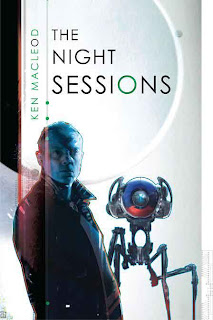
The Night Sessions: Pyr trade paperback, April 2012, 261 pages, cover art by Stephan Martiniere. Ken MacLeod is a four-time Hugo nominee among other honors, including a 2009 British Science Fiction Award for The Night Sessions, when it was originally published in England. The Night Sessions was one of our four seeded books for the Spring Battle of the Books. To make the finals, it defeated The Demi-Monde: Winter by Rod Rees in the first round then Simon Bestwick's The Faceless in the second round and finally Hell Train by Christopher Fowler in the semifinals.

The Night Sessions is set in a future where Western governments have all become strictly secular, as a reaction to the bloody "Faith Wars," and surviving organized religions are barely tolerated. The story centers on the investigation by Scottish Detective Inspector Adam Ferguson and his leki (robot) assistant of the murders of two Catholic priests, possibly victims of a terrorist conspiracy. We also get glimpses of J.R. Campbell, a Christian fundamentalist from New Zealand, who works with humanoid robots (as opposed to the mechanical-looking lekis), which seem to have some connection to the criminal conspiracy Ferguson is investigating.

The Man from Primrose Lane: Farrar Straus & Giroux hardcover, March 2012, 365 pages, cover photo by Michael Lewis. James Renner is a true-crime writer, making his debut as a novelist with The Man from Primrose Lane. It got here by beating Weston Ochse's Blood Ocean in the first round, then pulling two straight upsets over seeded books, Saladin Ahmed's Throne of the Crescent Moon in the second round and The Flame Alphabet by Ben Marcus in the semifinals. Renner will need to defy the oddsmakers a third time in the finals to win the championship.

The hero of The Man from Primrose Lane is crime writer David Neff, a single father after his wife's suicide, who is investigating the murder of the reclusive Man from Primrose Lane (the "MFPL"). In a series of seemingly bizarre coincidences, we learn that years earlier the MFPL saved David's wife Elizabeth from abduction as a child (but he couldn't save Elizabeth's twin sister) and he also once saved David's current romantic interest Katy, whom the MFPL had been following obsessively until his death. Even more unlikely, David's fame and fortune came from his previous cold case investigation of another child abduction, and now David himself has become the main suspect in the police investigation of the death of the MFPL. And yes, the book also has science fiction, fantasy, and horror elements. We'll get to that.

The Battle: I've often compared the Battle of the Books to the March Madness basketball tournament. I meant that we set the Battle up in a bracket format like the NCAA Tournament. I didn't realize until this championship match how apt the comparison really is. In this championship battle, The Night Sessions pulled out to a comfortable lead, only to see The Man from Primrose Lane make a spirited late comeback, culminating in a desperate long shot at the buzzer. The shot is up, it'll count if it goes, does it have the distance? . . .

I'm getting ahead of myself.

Through page 200, The Night Sessions continues to be a solid, well-executed near-future science fiction mystery. Giving the protagonist detective a robot sidekick invites comparisons to The Caves of Steel and The Naked Sun, and if this book isn't quite as memorable as Asimov at his best, it's not far off. The mystery is handled well, there's plenty of cool near-future techy furniture, and MacLeod does a nice job of thinking through the implications and difficulties of the transition from a religious to a secular society. The crowning touch is the artificially intelligent robots, who are most interesting and, to my tastes, very funny.

So I resumed The Man from Primrose Lane at page 100, with the bar set high. But MacLeod left one opening for James Renner: The Night Sessions does not feature characterization as strong as that in the first 100 pages of The Man from Primrose Lane. So what happened when I read through page 200 of Renner's book?

The tricky part of writing a cross-genre book is that you have different audiences with different expectations and backgrounds. Early in the second hundred pages of The Man from Primrose Lane, Renner brings in a science fictional element that I think most science fiction readers will find disappointing. But then right at the close of the first 200 pages, he hits us with another SF/F story element that works very well. Whatever your usual reading tastes, this is good stuff.

To explain further, I'll have to discuss some of these plot twists. If you trust my recommendation and plan to read The Man from Primrose Lane, you may prefer to skip below to "END SPOILERS." Science fiction readers can probably safely pass through my first spoiler alert. But continue through the double-spoiler alert at your own peril.

********************SPOILER ALERT********************

The Man from Primrose Lane sets up a number of strange, seemingly inexplicable mysteries, including who was the peculiar Man from Primrose Lane, why did he always wear mittens, and why are there so many connections between the MFPL and our protagonist David, his late wife Elizabeth, and his current girlfriend Katy?

Then at pages 109-128, we get two short scenes that, unintentionally I think, give away the answers to all these questions to most SF fans. One is a passing reference to David interviewing a physicist doing work that would allow objects to pass backwards through time. The other is a scene with a kid in 1985 who sees a strange frog-creature. The scene ends with the line, "He should have blamed a writer named David Neff." But David Neff was himself a little kid at that time, not yet a writer.

Perhaps mystery and mainstream readers won't make much out of these bits, but I think most science fiction fans will instantly know they are reading a time travel story. The MFPL is an older, time traveling David Neff, and that's why he appears out of nowhere to protect the women he will later love (dunno if Renner will try to explain the paradoxes). And by the way, time travel causes some sort of genetic reversion that makes you look like a giant frog at first, and later you'll have to wear mittens to conceal your webbed fingers. (Incidentally, I'm still at page 200, so I don't know if that's all correct, but I will be shocked and will post a sheepish update here if it isn't.)

It is still possible to write a fresh time travel story (I took a stab at it myself, with my story "Random Fire" in Abyss & Apex), but it's not possible to impress science fiction readers by the mere fact that strange happenings are explained by time travel. For Renner to construct his mysteries around this device is like a magician using his impressive stage presence to build up to the final trick of . . . pulling a rabbit out of his hat. It's cool only if you've never seen a magic show before.

So even though The Man from Primrose Lane is well written, with powerful characterization, I read most of the second hundred pages feeling disappointed. After 150 pages, The Night Sessions was going to win this battle. Even after 200 pages, The Night Sessions was going to win. But 200 pages ended in the middle of a scene, and the Battle of the Books rules allow me to finish the scene. And all my perceptions changed.

***************DOUBLE-SPOILER ALERT*****************

Much of the second hundred pages of The Man from Primrose Lane consists of flashbacks to the past, when David became obsessed with his investigation of past child abductions and murders, so obsessed that he starts to imagine the voice of one of the pedophiles in his head. Meanwhile, in present-day scenes, David is battling through withdrawal, because for the first time since Elizabeth died he has stopped taking his medication for depression.

Right at 200 pages we get a flashback that I won't reveal except to say it makes us realize that voice in David's head is not imagined—it is a real, evil presence, which is behind a lot of what's been going on, and which now has designs on Elizabeth. Maybe some horror readers guessed that while I was still assuming the voice in David's head was imaginary, but didn't get the time travel part of the story when I did.

Suddenly I don't mind figuring out one aspect of the story early on, when another aspect completely blind-sided me. And that new aspect immediately adds a layer of irony to much of what's happened. For example, I assumed David started taking his medication after Elizabeth died, but now realize he took it before she died, to try to control what he thinks is his own dark side. Yet sadly she ended up committing suicide anyway, or at least, so we've been told . . .

Now I'm right back in the saddle with this story, and it's a story that was already peopled with compelling characters.

********************END SPOILERS*********************

I find The Night Sessions very interesting intellectually, but The Man from Primrose Lane is the story I care about on an emotional level. No way would I willingly put it down.

THE WINNER: THE MAN FROM PRIMROSE LANE by James Renner

Congratulations to James Renner, who becomes our second Battle of the Books winner, after Elizabeth Bear. We will feature The Man from Primrose Lane in a full review at Fantastic Reviews, and we will also try to arrange an interview with Renner.

Stay tuned for the Summer Bracket of the Fantastic Reviews Battle of the Books, which we will announce in the next few days. I (Aaron) will hand off the judging for that one to my fellow Fantastic Reviewer Amy, and then I will return for the following bracket.

Sunday, June 17, 2012

Battle of the Books, Spring 2012, Second Semifinal :: The Flame Alphabet by Ben Marcus vs. The Man from Primrose Lane by James Renner

The Flame AlphabetMan from Primrose Lane
The second semifinal match of the Spring 2012 Fantastic Reviews Battle of the Books pits The Flame Alphabet by Ben Marcus against James Renner's The Man from Primrose Lane. The book I most want to continue reading after 100 pages will advance to the championship round.

The Flame Alphabet: Alfred A. Knopf hardcover, January 2012, 289 pages, cover design by Peter Mendelsund. Ben Marcus is a highly regarded mainstream author, but The Flame Alphabet is his first science fiction or fantasy novel. It reached the second round by defeating Mark Chadbourn's The Burning Man in the opening round and Eric G. Wilson's Everyone Loves a Good Train Wreck in the second round.

In The Flame Alphabet, an epidemic has made children's speech toxic to adults. Over the first 50 pages, our protagonist Sam and his wife Claire realized that their teenaged daughter Esther was the source of their ailment. Over the next 50 pages, even as Claire's condition worsens badly, they prove unwilling to distance themselves from Esther. Sam attempts to understand the disease through useless experiments and advice from his strange neighbor and his secretive religion.

The Man from Primrose Lane: Farrar Straus & Giroux hardcover, March 2012, 365 pages, cover photo by Michael Lewis. The Man from Primrose Lane is true-crime writer James Renner's first novel. It reached the second round by defeating Weston Ochse's Blood Ocean in the first round and upsetting a "seeded" book, Saladin Ahmed's Throne of the Crescent Moon, in the second round.

The opening 50 pages of The Man from Primrose Lane introduced the mystery, investigated by crime writer David Neff, of the murder of the reclusive Man from Primrose Lane (the "MFPL"). Over the next 50 pages, David meets with the detective assigned to the crime, who tells him the death may not have been murder at all, and with Katy Keenan, who never knew the MFPL and yet he kept a diary of her movements. All of this somehow connects to David's wife Elizabeth, who recently committed suicide, and whose twin sister was kidnapped as a girl and never heard from again.

The Battle: When mainstream authors write science fiction or fantasy, a key aspect they often get wrong is the suspension of disbelief. The reader has to feel like what's going on in the story is really happening, that it's not just a mental exercise. This requires the author to treat the fantastic elements seriously, and for the characters to react the way real people would (or at least might) if the story were actually taking place.

In the second 50-page section of The Flame Alphabet, Ben Marcus stumbles badly in this respect. In the first 50 pages, he established a worldwide affliction so severe it threatens the existence of the entire human race. But then he goes off on lengthy tangents about the protagonist's peculiar, secretive sect of Judaism. Sam has to go to a hut in the woods to hear sermons through a strangely organic "listener," which he assembles and is required to hide when the sermon is over. On page 80, Sam is mortified to realize he left the listener in the hut, so an outsider conceivably could hear one of the sermons. This scene would work fine in an angsty mainstream novel about a guy in a midlife crisis. In the middle of a story about the human race in an existential crisis, it feels completely trivial. Ditto Sam's sense of awkwardness in conversations with his weird neighbor. For Marcus to focus on these trivial aspects of the story suggests he is not taking his own apocalyptic story concept seriously.

Even worse, his characters don't seem to take it seriously. Neither the protagonist Sam nor his wife Claire nor anyone we've seen acts the way people would act if this story were really happening. By 50 pages into the novel, it has been established that people are dropping dead all over the place, and although nobody understands it, they all know the deaths are caused by the speech of children. Yet through 100 pages, with Claire nearing death, Sam has never once told his daughter Esther to shut the fuck up. In real life, parents tell their kids to shut up when they can't hear the television, but in this book Sam can't bring himself to say it with Claire's life in danger? On a societal level, Marcus has made passing reference to the fact that some parents have sent their children away or have gone to hide in the hills, but has failed to address the turmoil that would entail. How would people heading to the hills even survive, with society collapsing?

Another example: when some children pass by, the weird neighbor sticks some gloop into Sam's mouth and suddenly the children's speech isn't painful to Sam. This action was uninvited and undertandably upsets Sam. But it would take a real person about five seconds to get over that revulsion and say something like, "What was that stuff and can I have some for my dying wife?" Instead, Sam just avoids the guy.

Ben Marcus seems to be focused on the metaphorical import of his book's concept, at the expense of the story. So he shows roving packs of kids intentionally shouting at adults to hurt them for a lark. This may symbolize generational conflicts somehow, but on the level of story, I just don't buy it. I believe most kids would be worried for their families and afraid about what will happen if all the adults die; what's more, I think that would make for a more powerful story.

Meanwhile, in the second fifty-page section, the story of The Man from Primrose Lane just keeps getting better. Each scene in this section builds on one of the levels of the story, all of which work well individually, and we're starting to see more connections between the different levels.

So in one scene, David interviews Detective Sackett about the death of the MFPL. Sackett (the detective we saw in the Prologue, who I'm delighted to have back onstage) tells David that the victim did not die from his gunshot wound, but from blood loss when his fingers were cut off and put in his blender. Sackett believes the man cut off his own fingers to destroy his fingerprints, so as to continue to hide his identity, which also explains why he always wore mittens even in hot weather. At the same time, David learns that Sackett is conducting a cold-case investigation of a child abduction: the kidnapping of Elaine, the sister of David's late wife Elizabeth. David and Sackett both notice the uncanny resemblance between Elaine and Katy, the woman with whom the MFPL was obsessed. The realization about the fingers in the blender makes the mystery story more intriguing to me than a typical whodunit. At the same time, this scene establishes that the mystery is connected somehow to David, his late wife, and her missing sister. I'm skeptical that Renner can convincingly explain these coincidences, but at this point I'm enjoying things so much I don't care.

Before and after this interview, Renner gives us flashbacks to David and Elizabeth's wedding and honeymoon. Elizabeth was already mentally fragile at that time, and David knew it. So he panics when she says, "I can't do this," and urgently tries to convince her that things will work out, before realizing she meant she didn't know how to use her chopsticks. These scenes are charming, but with a bittersweet undercurrent, because the reader knows these happy times will turn sour enough for Elizabeth to commit suicide. Indeed, we learn she was already having suicidal thoughts even on the honeymoon, from which she turned aside in a terrific scene I don't want to spoil, except to say it relates to the mystery of the MFPL.

Renner follows that up with a sweet scene in the present day with David and his son Tanner, then an interview/date with Katy. We learn that Katy was nearly abducted as a girl in the same way Elaine was ten years earlier, but was apparently saved by the MFPL. Meanwhile, Renner throws in little details, like Tanner's obsessive hobby and odd pictures of people with clown noses in the restaurant where David takes Katy, which are amusing but also relevant to the story. And we finally get some fantastic elements, for example flashbacks to creepy and inexplicable events that followed the materials sent by an executed serial murderer to the paper where David worked when he first became a crime writer.

Then the fifty-page section ends with David realizing he is a suspect in the death of the MFPL.

If a book gets to the semifinals of the Battle of the Books, it means I really like the author's writing and the story concept. Now in the semifinals, as I get deeper into the tale, the question is whether the author can maintain and build on whatever interested me in the story, or whether things will start to unravel. In pages 51-100, The Flame Alphabet lost me, while James Renner successfully pulled me deeper into the story of The Man from Primrose Lane.

THE WINNER: THE MAN FROM PRIMROSE LANE by James Renner

The Man from Primrose Lane advances to the championship match, to take on The Night Sessions by Ken MacLeod.

To see the whole bracket, click here.

Thursday, June 14, 2012

Battle of the Books, Spring 2012, First Semifinal :: Hell Train by Christopher Fowler vs. The Night Sessions by Ken MacLeod

Hell TrainThe Night Sessions
The first semifinal of the Spring 2012 Fantastic Reviews Battle of the Books matches Hell Train by Christopher Fowler against The Night Sessions by Ken MacLeod. The book I most want to continue reading after 100 pages will advance to the championship round.

Hell Train: Solaris paperback, January 2012, 319 pages, cover art by Graham Humphreys. Five-time British Fantasy Award winner Christopher Fowler has written some thirty books, most of them horror or mystery. Hell Train got to the semifinals with wins over Greatshadow by James Maxey in the first round and Tempest by Julie Cross in the second round.

After an initial scene in 1966, in which a screenwriter is asked to write a new horror movie for Hammer Films involving a train, the story of Hell Train has settled into a World War I setting. British con artist Nicholas Castleford has persuaded Isabella, an Eastern European beauty, to run away with him, and they have escaped the locals on an ominous train. Also catching the train are an English vicar and his shrewish wife (I can say "shrewish" without fear of being accused of gender bias, since Fowler actually describes her with that word), a fortune-telling countess, and a young man wracked with guilt over his role in the start of the Great War.

The Night Sessions: Pyr trade paperback, April 2012, 261 pages, cover art by Stephan Martiniere. Ken MacLeod is a four-time Hugo nominee among many other honors, and The Night Sessions won the 2009 British Science Fiction Award for best novel. The Night Sessions reached the second round of the Battle of the Books by defeating The Demi-Monde: Winter by Rod Rees in the first round and Simon Bestwick's The Faceless in the second round.

The Night Sessions is set in a future where the bitter "Faith Wars" have turned most folks in the West against organized religion. While much of the first 50 pages followed J.R. Campbell, a Christian fundamentalist from New Zealand, pages 51-100 exclusively track Scottish Detective Inspector Adam Ferguson and his leki assistant (the robot on the cover) as they investigate the murders of two Catholic priests. They collar a suspect, but the clues against the man are so obvious—he delivered the package containing the bomb that killed the first priest, and he was spotted with a rifle in the area where the second priest was shot—that anyone who has read many mysteries must doubt he's the real culprit.

The Battle: These two books are a hoot, and based on the first 100 pages, I strongly recommend them both. Each delivers exactly what it promises to readers. This battle will come down to which book adds an extra unexpected element.

Hell Train is a pitch-perfect literary homage to the Hammer Studios horror films of the 1950s and '60s. I'm not sure yet if Peter Cushing should play the rogue Nicholas, but the train's conductor is all Christopher Lee:
The figure slowly turned to stare at him, as he might peer at an insect. He had a pair of lethal-looking silver clippers in his right hand. 'I am the Conductor of the Arkangel,' he replied in perfect English. He was as pale as ivory. The low timbre of his voice resonated from somewhere deep and far away. Although deeply set in the caves of his skull, his shining black eyes missed no detail.

'Well, what is our destination?' asked Nicholas sharply.

'That must depend on you.'

'Perhaps you didn't understand the question. Where does the train terminate?'

'We need to stay on board until we cross the border,' asked Isabella. 'Is that possible?'

'You will finally come upon a border, yes.'
Hell Train isn't all that frightening so far, but the mood of the piece is just right.

Meanwhile, The Night Sessions presents a most interesting future in which there has been a backlash against organized religion. Many science fiction novels assume that society will move away from religion in the future, but fail to consider the turmoil that shift would entail. MacLeod does a wonderful job of showing the uneasy new equilibrium in his secular future. What's more, the murders of two of the remaining Catholic priests suggest that some of the anti-religious forces are just as fanatical and intolerant as any religious fundamentalist. All this is presented in a future with interesting extrapolations of current political and technological trends. Very nice near-future SF from one of the top writers in the field.

So what's the tie-breaking extra element? I absolutely love the artificially intelligent robots in The Night Sessions. Piltdown, the humanoid robot stuck playing an ape-man in a creationist park, was a star of the first 50 pages, and now in the second 50 pages, we start to see the personality of Skulk, Detective Ferguson's tripedal leki assistant, as in this scene where he analyzes some threatening anti-Catholic literature:
". . . Taken together, the broadsides are—to use an old term—a fatwa, a legal ruling by a competent religious scholar. Consequently, if we were to find someone who did accept these premises we would have a prima facie suspect."

"Sometimes," said Ferguson, "I suspect the expression 'No shit, Sherlock' was coined with lekis in mind."

"It was not," said Skulk. "The earliest examples of the usage pre-date—"

"I was joking," Ferguson interrupted.

"So was I," said Skulk. "I appreciate your humour." 
His robots' dry wit put MacLeod over the top.

THE WINNER: THE NIGHT SESSIONS by Ken MacLeod

The Night Sessions advances to the championship match, where it will face either The Flame Alphabet by Ben Marcus or The Man from Primrose Lane by James Renner.

To see the whole bracket, click here.