Sunday, September 05, 2010

Aaron's Story Recommendation of the Week :: It Shall Come to Pass on a Summer's Day by Lenora Rose


Who the hell is Lenora Rose? How does an author who has never appeared in any publication I've ever heard of suddenly pop out of nowhere with a story as beautiful and powerful and thought-provoking as It Shall Come to Pass on a Summer's Day, in the September 2010 issue of Ideomancer? Could she really be a new pseudonym of Catherynne Valente or Rachel Swirsky, or Ursula LeGuin for that matter?

"It Shall Come to Pass on a Summer's Day" is narrated by a selkie with the gift(?) of prophecy. As he awaits his pregnant lover he foretells what lies ahead of them. The story is told in future tense, not because Lenora Rose is showing off that she can do it, but because that is exactly how this story needs to be told. The protagonist foresees the future, including his own attempts to use his prophecies to manipulate the future, but the best he can apparently hope for is to survive to a bittersweet end:
Or he may come bid me be a man and talk, though even in that possible fate I cannot see what I would ever have to say to him, who will have over forty years of honest love where I have a handful of days.
This is a gorgeously written piece that manages in less than 1,500 words to engage with the implications of being able to see the future in unique and memorable fashion. Here's hoping to see much more of Lenora Rose in our future.

Saturday, September 04, 2010

Aaron's Take on the 2010 Hugo Nominees :: NOVELS

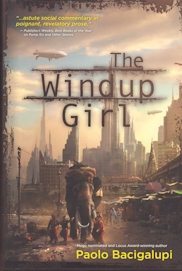
cover of The Windup GirlThe biggest problem with this year's best novel category is that there is only one rocket to go around. I like to see the Hugo Award go to a novel that is unique and memorable and thought-provoking and superbly written. Three of this year's nominees, the Bacigalupi, Miéville, and Valente novels, meet those criteria for me.

Out of a very strong field, my #1 choice is The Windup Girl by Paolo Bacigalupi. Bacigalupi is only the third author of the past 25 years to see his first novel nominated for both the Hugo and Nebula Awards, and The Windup Girl is just the sort of once-in-a-generation reading experience that suggests. The novel combines an absorbing story with one of the most fascinating settings I've ever encountered, Bacigalupi's vision of future Thailand. Paolo Bacigalupi will be one of the leading voices of the SF field (and all of literature) for as long as he wants to be. A Hugo Award would be a great way to urge him on to a very long writing career.

China Miéville's The City and the City also features a tremendously inventive setting, the coexisting cities of Beszel and Ul Qoma. The way the inhabitants of both cities learn to unsee one another is fascinating and a powerful metaphor for how people manage to train themselves to avoid facing what is right in front of them. I enjoyed this novel throughout, even though the murder mystery plot is not entirely successful.

Catherynne M. Valente writes in a lush, ornate style that I would detest, except that she does it so exceedingly well. Palimpsest is a beautifully written novel, with striking imagery and a great deal to say about love and sex and the barriers that separate all of us. Valente is one of the very best authors in our field, and I am delighted Palimpsest received a Hugo nomination.

For me, whether I enjoy Robert J. Sawyer's work usually turns on if the ideas of a particular book are interesting enough to overcome the clunky writing. The ideas in WWW: Wake, including a blind woman gaining sight as she encounters an emerging intelligence existing in the Internet, would be strong enough to pass that test but they didn't have to, for I didn't find the writing of WWW: Wake clunky at all. In particular, I would not have thought Sawyer up to the challenge of conveying what it might be like for a blind person to gain eyesight for the first time, yet I found those passages in this novel very powerful and moving. Still, Sawyer can't quite compete with Paolo and China and Cat.

I enjoyed Cherie Priest's Boneshaker, a steampunk zombie adventure that has a lot more going for it than that gimmicky hook might suggest. As described in more detail in my review, Boneshaker is most entertaining, even if not tightly written, but does not compare favorably with the other outstanding works in this category. The same is true for me of Robert Charles Wilson's Julian Comstock, about which I will say nothing more, because I must confess the novel didn't catch my interest enough for me to finish reading it.

With the range and quality of works on this ballot, this is an exciting time to be a science fiction and fantasy reader. I wish I were down under right now, to see one of these outstanding authors receive his or her well-earned recognition.

Aaron's Ballot for Best Novel
1. Paolo Bacigalupi - The Windup Girl
2. China Miéville - The City and the City
3. Catherynne M. Valente - Palimpsest
4. Robert J. Sawyer - WWW: Wake
5. Cherie Priest - Boneshaker
6. Robert Charles Wilson - Julian Comstock

Aaron's Take on the 2010 Hugo Nominees :: DRAMATIC PRESENTATION, LONG FORM

The Hugo Awards are only a few hours away, which makes this my absolute last chance to declare in advance (barely) what should win, rather than whining about what should have won.

One of the most closely followed categories is Dramatic Presentation, Long Form (i.e., SF movies), even though the creators of the nominees often couldn't care less about the Hugo Awards. More to the point, the nominees often suck.

This year, however, we have a very strong slate of nominees, nearly rivaling the 1983 ballot, which included such classics as Blade Runner, Star Trek II: The Wrath of Khan and E.T. In many a year, District 9 would be my hands-down first choice for the dramatic presentation Hugo, but this year I had to stick it down at #4 on my ballot, in favor of even better films.

Before we get to all that good stuff, however, let's dispose of the one nominee I disliked, the 2009 version of Star Trek. I acknowledge that this movie was entertaining, but I just hated it, largely because I am a big fan of the original Star Trek series. And this movie is emphatically not Star Trek. The one-dimensional characters: not Star Trek. (Compare the moronic Romulan villain in this movie to the Romulan commander in the "Balance of Terror" episode.) The ridiculous woo-woo science: not Star Trek. The cartoonish visuals: not Star Trek. The huge water pipe in the Enterprise's engineering section, the lack of handrails on the Romulan ship (plus knee-deep water--apparently it had one of those huge pipes too, and it froze), the fistfights and swordfights between characters who are carrying phasers, all of that would be at home in a Star Wars prequel or maybe Galaxy Quest but please don't call it Star Trek. The sad thing is most of this could have been fixed with a few lines of dialogue here and there, but the makers of this film didn't care enough to bother. This film is an old-style Hollywood assault on its viewers' intelligence, as bad as any 1950's black-and-white skiffy you can find.

With that rant out of the way, let's get to all the good news. I enjoyed District 9, an intelligent film with something to say about race and class barriers. The film had an interesting look, juxtaposing all-too-familiar slum areas with the visually striking alien creatures. But the movie can't make up its mind whether it wants to pretend to be a documentary——too much of the footage obviously would not have been available to the hypothetical documentary filmmakers——and I think it was a mistake to make the main character such a twit at the outset.

Up is another delightful success from Pixar. The movie features a grumpy old man protagonist and pulls it off remarkably well. And hearing the dogs' thoughts——"I will go get the ball!!! And then I will bring it back!!!"——was worth the price of admission by itself.

Moon is a cleverly written film, with some memorable twists. Sam Rockwell gives an unforgettable performance. The slow pace and grand visuals (despite the low budget) are a marvelous tribute to a prior generation of movies such as 2001 and Silent Running. I especially like the way the GERTY emerges as sort of a converse of HAL from 2001. This is a terrific movie, and I will be happy if it wins the Hugo, even though it is not my #1 choice.

My top choice is the highest-grossing film ever, Avatar. This movie is 37 different kinds of awesome, and I can't believe how blasé many fans of SF literature are about it. Some complain that the film is a rip-off of Ursula K. LeGuin's The Word for World Is Forest and Poul Anderson's "Call Me Joe." But to me, for Hollywood to draw inspiration from Ursula LeGuin or Poul Anderson is a very good thing. This film is visually stunning but also intelligent. The storyline may be fairly standard and straightforward, but the movie treats it with enough respect that it works. I can't remember when I last enjoyed a movie this much, and I hope the Hugo voters were not too snobbish to give Avatar the recognition it deserves.

Aaron's Ballot for Best Dramatic Presentation, Long Form
1. Avatar
2. Moon
3. Up
4. District 9
5. Star Trek

Tuesday, August 31, 2010

Amy's bookshelf :: The Many-Colored Land by Julian May

cover of The Many-Colored LandThe Many-Colored Land by Julian May (1981) (cover art by Michael Whelan), volume one of the Saga of Pliocene Exile, is a science fiction book with some mythical aspects more commonly associated with fantasy. It was a 1982 Hugo Award nominee for best novel. I read the book some years ago and remember enjoying the entire series immensely.

In the 21st century Human Polity of the Galactic Milieu a portal is created in France allowing a one-way trip back in time to the Pliocene Epoch five million years ago. For years people -– adventurers, romantics, fanatics, conservatives, social misfits, the broken-hearted -- chose to exile themselves to the past. Many hope to find a simpler world. What they find is not at all what they expected.

There are two races of warring aliens, the tall, elf-like Tanu and the dwarf-like, gnome-like and ogre-like Firvulag. Both have seemingly magical powers called metaphysical talents. The books follow the fate of a group of exiles from 2110 who are split up upon arrival in the Pliocene.

The Many-Colored Land doesn't standalone. This first book in the series mainly sets up the story and introduces the characters. The rest of books in the Saga of Pliocene Exile are The Golden Torc, The Nonborn King, and The Adversary. Recommended.

Monday, July 19, 2010

Aaron's Take on the 2010 Hugo Nominees :: NOVELETTES

Eros, Philia, AgapeBest novelette is the most difficult category for me to rank this year. I find three of the nominees outstanding——the Eugie Foster, Rachel Swirsky, and Peter Watts stories——and have trouble selecting between them. The good news is I will be happy if any of them wins the award.

After much deliberation, my top ranking goes to Rachel Swirsky's "Eros, Philia, Agape." It is arguably not quite so ambitious as the Foster and Watts stories, but the execution is flawless. The protagonist of "Eros, Philia, Agape" acquires a male robot programmed to develop a personality that conforms to all her desires, yet somehow this proves not enough for a lasting relationship. I recommended this story when it first appeared, and I stand by my assessment that it is a wonderfully subtle meditation on universal issues about identity and love and marriage and family and parenting.

My second choice by the narrowest of margins is "Sinner, Baker, Fabulist, Priest; Red Mask, Black Mask, Gentleman, Beast" by Eugie Foster. This is a beautifully written story built on an intriguing premise, a world where each person puts on a different mask every morning and subsumes herself within the role that mask represents. The whole society is thus comprised of individuals lacking, or at least unaware of, individual personalities. Not surprisingly, our protagonist(s) ends up questioning this way of life, but Foster's resolution of the story was not entirely satisfying to me.

"The Island" by Peter Watts is perhaps the most intellectually fascinating of the nominees, combining a provocative first contact scenario with the politics on a starship engaged in an eons-long journey to construct wormholes for interstellar travel. But it didn't grab me emotionally as the Swirsky and Foster stories did. Watts is not entirely successful at conveying his protagonist's despair, and he waits far too long to reveal important things that she knew or should have known much earlier.

"Overtime" by Charles Stross is a Christmas entry in Stross' Laundry series, in which superspies battle Lovecraftian horrors despite the constraints of their Dilbertesque bureaucracy. Their high tech office includes, for instance, a rotary phone, because "the NDO's office budget was misfiled years ago and nobody knows the correct code to requisition new supplies." This is an entertaining story that does everything it sets out to do, but is just not as memorable as the previous three nominees.

Nicola Griffith's "It Takes Two" is an engrossing story. Griffith does a wonderful job of putting the reader into the skin of a woman falling in love. Add to that the tension from the reader's suspicion that something is not right about this love affair, and the first half of the story works very well. Unfortunately, we then find out what's not right, and the story abruptly stops working. There is no believable reason for the protagonist to have agreed to the elaborate procedure described, and her stated reason for agreeing (she didn't want to feel uncomfortable going to a strip club) is so flat-out preposterous that the whole story falls to pieces.

Finally, Paul Cornell's "One of Our Bastards Is Missing" is an inoffensive SF locked room mystery, involving a strange disappearance at the wedding of a British princess. There is nothing wrong with this story but neither is there anything award-worthy about it. I can only assume it made the ballot thanks to a certain segment of fans (you know the ones——they talk funny and they nominated every eligible episode of Doctor Who) who are fascinated with the royal family.

Aaron's Ballot for Best Novelette
1. Rachel Swirsky - Eros, Philia, Agape
2. Eugie Foster - Sinner, Baker, Fabulist, Priest; Red Mask, Black Mask, Gentleman, Beast
3. Peter Watts - The Island
4. Charles Stross - Overtime
5. Nicola Griffith - It Takes Two
6. Paul Cornell - One of Our Bastards Is Missing

Sunday, July 18, 2010

Aaron's Take on the 2010 Hugo Nominees :: DRAMATIC PRESENTATION, SHORT FORM

A grassroots effort to turn the Dramatic Presentation, Short Form category into "Best Doctor Who Episode" was thwarted by the fact that only three Doctor Who episodes were released last year. I'm not sure it was necessary to nominate all three, but at least they are good examples of the form, and the two non-Doctor nominees are strong enough to make this a solid list overall.

Let's dispose of the Doctor first. To my tastes the best of the three nominated episodes is "The Waters of Mars," in which the Doctor encounters a body-snatching alien life form. Its appearance comes at a critical moment in history, and for once the Doctor is convinced he should not interfere. His frustration at being unable to help lends an effective "Cold Equations" feel to the episode, and it is appropriate that the action he finally takes does not turn out as intended.

"The Next Doctor" is also a strong episode. The identity of the "next doctor" makes a nice mystery, although Russell Davies made the right choice in not waiting until the end of the show to reveal the answer. The episode has some strong dramatic moments, despite a disjointed story and the actors hamming it up in typical Who fashion. The King of the Cybermen strolling through 1850's London is an effective ending image, but then Doctor Who was doing steampunk long before it was cool.

Less successful is "Planet of the Dead," which features a nonsensical plot, beginning with perhaps the most egregious example yet of the Doctor just happening to be there when bizarre stuff happens——naturally, he'll be riding the one bus in the history of London to be pulled through a wormhole——and ending with no explanation of why this swarm of nasty critters should open a wormhole to attack Earth but then wait exactly as long as the Doctor required before trying to zip through the hole. Meanwhile, the interaction between the Doctor and wannabe companion Lady de Souza feels forced.

"No More Good Days," the premier episode of FlashForward, combines an interesting premise (thanks to Robert Saywer) with good acting and nice effects. David Goyer's direction is intrusive at times, for example circling the camera around conversing characters until the viewer's head swims, but by the end he managed to build up the tension nicely. This was a solid opener to the series, but we have learned recently that Hollywood TV introduces SF plotlines far better than it resolves them.

By far my favorite of the nominees is "Epitaph One," the made-for-DVD final episode of Season One of Dollhouse. I watched Dollhouse from the outset, and like many viewers I felt the show got off to a slow start and was borderline offensive in its easy acceptance of the deeply immoral technology involved, which it treated initially as just a fun way to produce great prostitutes. Thankfully, by the end of Season One Joss Whedon made it clear that the main storyline would be Echo's struggle to retain her identity and defeat the evil minds behind the Dollhouse. "Epitaph One" showed us how much is at stake, with a glimpse of a future where Dollhouse technology has destroyed civilization. I found the episode gripping in itself, and also a huge step forward for the show, although the second season did not quite deliver on that promise.

Incidentally, because the character of Echo is offstage through nearly all of "Epitaph One," Eliza Dushku's detractors may vote for it with a clear conscience. I'm actually of the minority view that Dushku's acting was a strength of Dollhouse. She was not entirely convincing in all of the different roles Echo assumed, but then it was important to the show that she not be entirely convincing. However Echo was imprinted, we needed to see flashes of the same core personality, a core personality that was confused and uncertain. Perhaps this is a case like William Shatner in the original Star Trek, where an actor's flaws are happily well-suited to the character (I haven't seen enough of Dushku's work to say), but I thought she pulled that off perfectly.

"Epitaph One" was the strongest episode of a show that, despite its flaws, was the best SF on television in 2009.

Aaron's Ballot for Best Dramatic Presentation, Short Form
1. Dollhouse, "Epitaph One"
2. Doctor Who, "The Waters of Mars"
3. FlashForward, "No More Good Days"
4. Doctor Who, "The Next Doctor"
5. Doctor Who, "Planet of the Dead"

Thursday, July 08, 2010

Aaron's Take on the 2010 Hugo Nominees :: GRAPHIC NOVELS


I am no expert on graphic novels, but the point of including this category in the Hugo Awards is to highlight graphic works that should appeal to readers of prose science fiction and fantasy. So as a devoted SF/F prose reader, here is my take on the graphic novel (er, "graphic story") Hugo nominees.

By far the strongest of the five nominees to me is Batman: Whatever Happened to the Caped Crusader? This is a wonderful tribute to the character of Batman, a fitting end to DC's run of sequentially numbered Batman comic books. I'm sure to a long-time Batman fan the tribute comes across even more powerfully, as Neil Gaiman and Andy Kubert have deliberately patterned sections of the story after various Batman creators of old. Even ignoring how this volume riffs on the history of Batman, it is a delightful book for its meditation on the significance of any old, oft-repeated tale. It is such a beautifully written story, I suspect most fans could identify it as the work of Neil Gaiman even if his name were left off the cover.

One reason I don't read more graphic novels is that I have long since tired of the superhero concept, in just the way I have tired of vampire stories. So there could hardly be a worse combination for me than Captain Britain and MI13: Vampire State, a graphic novel in which a group of superheroes battle Dracula and other vampires. Yet I found it impossible not to enjoy this book. Writer Paul Cornell crafted a strong storyline with many nice touches, such as the opening image of Dracula on the moon, dragging his boot across Neil Armstrong's footprint. I love how Cornell conveys the characters' Britishness, even including a long flashback to a superheroes' game of cricket. The tale is easy enough to follow despite the large extent of backstory built in, and the artwork by Leonard Kirk and several others is wonderfully vivid.

By all reports, and judging by its multiple Eisner Awards, Bill Willingham's Fables, peopled by a huge cast of reimagined storybook characters, has been one of the most inventive series of the past several years. After several books focused on the struggle against the "Adversary," the current Hugo nominee, Volume 12: The Dark Ages, begins a different story arc and introduces a new villain. This volume is somewhat lacking in drama, since the new conflict remains far from resolution by the end, but there are still plenty of clever moments. I particularly enjoyed the appearance of Fritz Leiber's characters Fafhrd and the Gray Mouser.

The highlight of Girl Genius: Agatha Heterodyne and the Heirs of the Storm is the striking artwork by Phil Foglio (with lush colors by Cheyenne Wright). It's a good thing the book has such strong visual appeal, because the story ranges from jumbled to incoherent. I'm at a disadvantage for not having read all the previous volumes, but I'm hard pressed to see how anyone could care about the dense layers of background information that come into play. The humor is hit-or-miss, for me more miss than hit, although I admit I laughed out loud a couple times. A final strike against this is the abrupt "to-be-continued" ending.

Howard Tayler's Schlock Mercenary is a long-running webcomic, done in the newspaper style, with a punchline at the end of each strip. Like most comic strips, I find the humor erratic. (The only daily comics that ever struck me as consistently funny were Bloom County and Calvin and Hobbes, so my standards are admittedly rather high.) While the volume of Schlock Mercenary nominated for last year's Hugo Award had some funny moments, I'm sorry to say the new edition, subtitled The Longshoreman of the Apocalypse, did not make me laugh. That doesn't leave much to hold interest, for the story is routine at best (our mercenary heroes deliver a shipment of food to a space station) and takes far too long to develop.

Aaron's Ballot for Best Graphic Story
1. Neil Gaiman, Andy Kubert & Scott Williams - Batman: Whatever Happened to the Caped Crusader?
2. Paul Cornell, Leonard Kirk & Mike Collins, et al. - Captain Britain and MI13: Vampire State
3. Bill Willingham & Mark Buckingham, et al. - Fables: The Dark Ages
4. Kaja & Phil Foglio & Cheyenne Wright - Girl Genius: Agatha Heterodyne and the Heirs of the Storm
5. Howard Tayler - Schlock Mercenary: The Longshoreman of the Apocalypse

Wednesday, June 30, 2010

Aaron's Take on the 2010 Hugo Nominees :: NOVELLAS

cover of The God EnginesBest novella is a strong category this year. Even though this is certainly the fiction category with the fewest eligible works published, the voters managed to find six worthy nominees. All of the nominees will have their supporters——several of the nominated authors are popular with the Hugo voters, plus Kage Baker will have a sympathy vote due to her untimely death——but my guess is John Scalzi will win a Hugo for the third straight year, his first in a fiction category.

Kage Baker's "The Women of Nell Gwynne's," a steampunk mystery with a group of prostitute/spies as lead characters, is mostly light entertainment but does have an appropriately dark edge when showing us why some of our heroines would choose this life. The tale features some wonderful dialogue and is great fun to read, but the whodunit does not satisfy and the story feels less complete than the other nominees. My guess is "The Women of Nell Gwynne's" was meant as the first in a series of stories about these remarkable ladies——see for instance my recommendation for The Bohemian Astrobleme——which sadly will now never be completed.

"Palimpsest" by Charles Stross is a time travel story on a very large scale. While it begins with the cliché of a time traveler killing his own grandfather, the tale quickly moves on to grander and more original issues about the fate of humanity over the next billions, even trillions, of years. The folks directing human destiny control time travel technology, although oddly their grand plans mostly involve moving planets around, not time travel. Stross throws plenty of interesting ideas at us, but fails to include strong enough characters to provide the emotional hook to carry us through this type of Stapledonian epic. The main character has very little personality, and his two girlfriends have none at all.

"Act One" by Nancy Kress, a former story recommendation of the week, explores the morality of an attempt to impose genetic modifications on humanity to give everyone a greater sense of empathy. This is a near-future story on a much smaller scale than "Palimpsest," but the superior characterization makes "Act One" more successful overall.

James Morrow is the best satirist in our field, and one of the two best ever along with John Sladek. "Shambling Towards Hiroshima" exemplifies his trademark dry humor. The protagonist is a Boris Karloff-style creature-feature actor, called on during World War II to give the Japanese a demonstation of the damage that will be inflicted, if they don't surrender, by a fearsome weapon the United States has developed: monstrous fire-breathing lizards. Morrow has great fun writing of the B-movie culture of 1940's Hollywood, but he doesn't quite manage to combine this with his serious point as seamlessly as in his best work. The goofy monster movie material takes over the story, while the endnote as to the morality of weapons of mass destruction feels tacked on.

Ian McDonald's "Vishnu at the Cat Circus" is the fascinating life story of a genetically engineered slow-aging super-genius who was instrumental, along with his unmodified brother, in the radical transformation of India. In contrast to "The Women of Nell Gwynne's," which suffered because it felt like the opening chapter of a larger unfinished work, "Vishnu at the Cat Circus" is impressive because it stands alone very well yet also is a terrific capstone to Ian McDonald's series of stories (as well as the novel River of Gods) set in a future India.

While all the nominees in this category are very good, my favorite is John Scalzi's "The God Engines," the thought-provoking story of Ean Tephe, captain of a starship powered by an enslaved god, captured and harnessed by the god Tephe worships. Not surprisingly, Tephe comes to doubt his faith in his own god, but from there matters do not play out as you might expect. The tale is an interesting blend of science fiction, fantasy, and horror elements.

John Scalzi has emerged in the past five years as one of the field's most capable authors, but at times he relies too heavily on snappy dialogue, rather than attempting something with more depth and emotional impact. "The God Engines" is thus a breakthrough work for him. Scalzi sets aside his usual sardonic humor in favor of original, intricate world-building and a compelling protagonist caught in the teeth of a dilemma from which there may be no way out. All of Scalzi's fiction is entertaining, but "The God Engines" is his best yet.

Aaron's Ballot for Best Novella
1. John Scalzi - The God Engines
2. Ian McDonald - Vishnu at the Cat Circus
3. James Morrow - Shambling Towards Hiroshima
4. Nancy Kress - Act One
5. Charles Stross - Palimpsest
6. Kage Baker - The Women of Nell Gwynne's

Thursday, June 10, 2010

Book Review Teaser :: Boneshaker by Cherie Priest

cover of BoneshakerNew on Fantastic Reviews is Aaron's review of Boneshaker by Cherie Priest. This book is one of the current 2010 Hugo award nominees for Best Novel.

From Aaron's book review of Boneshaker :
"Boneshaker is a steampunk zombie novel, but much less gimmicky and more accomplished than this label suggests...."

"Boneshaker is set in Seattle circa 1880, but a steampunk alternate version of Seattle largely destroyed when Dr. Leviticus Blue's massive "boneshaker" drill undermined the city's foundations while simultaneously releasing a lethal subterranean gas that renders its victims zombies. Blue was never heard from again after the disaster, but his wife Briar Wilkes and son Zeke - unborn when Blue disappeared but now fifteen years old - scratch out a living in the outskirts of the ruined city, outside the immense walls that hold in the gas blight and zombies"

"Convinced history has treated his father unfairly, Zeke puts on a gas mask and follows an underground tunnel into the city on a quest to clear Leviticus Blue's name. With impeccable teenager logic, he braves the city alone, without telling his mother of his plans. The story begins in earnest...when an earthquake collapses the tunnel, and Briar sets out to rescue Zeke by airship...."

To read the entire review -> Boneshaker

Wednesday, May 12, 2010

Aaron's Take on the 2010 Hugo Nominees :: PROFESSIONAL ARTISTS

cover of Always ForeverThe five Hugo-nominated professional artists are all outstanding, each in his own way, and we are blessed to have artistic talent like theirs in our field. I don't have the expertise to evaluate the artists' relative degrees of craft and technique, but I can say whose work most catches my attention and most rewards repeat examinations, whose cover art makes me want to read the book just so I can carry that gorgeous cover around.

The two artists who consistently draw that reaction from me are Stephan Martiniere and John Picacio. As much I love every Martiniere cover, I will have to rank Picacio #1 this year, because 2009 saw some of his most striking work yet. Let me call particular attention to his covers for Mark Chadbourn's Age of Misrule series, from Pyr Books (which never disappoints with its cover art). The covers are beautiful individually, but even more memorable for their progression through the series, from the torso of the immense mythical creature on the cover of World's End (dwarfing our heroes in the foreground) to the head on Darkest Hour to finally the Sauron-esque eye on Always Forever. Amazing stuff!

This should take nothing away from the other excellent nominees. Shaun Tan's Tales from Outer Suburbia is a terrific showcase of his work, even if it suffers a bit by unfair comparison to his wonderful book The Arrival from 2007. I hate to put Bob Eggleton all the way down at #4, as he has been one of the most reliable artists in the field for many years, but then again he already has nine Hugo Awards to show for that body of work. Daniel Dos Santos is also very good, although his style is slightly less to my tastes than the other nominees. Suffice to say that whoever wins the award will be a very worthy recipient.

Aaron's Ballot for Best Professional Artist
1. John Picacio
2. Stephan Martiniere
3. Shaun Tan
4. Bob Eggleton
5. Daniel Dos Santos