Showing posts with label 2009. Show all posts

Saturday, February 12, 2011

Book Review Teaser :: Ash by Malinda Lo

Ash cover artNew on Fantastic Reviews is Aaron's review of Ash by Malinda Lo.

From Aaron's book review of Ash :
"Ash by Malinda Lo is a beautifully written novel, combining modern sensibilities with the elegant, wistful voice of a fairy tale. Published as a young adult novel, but equally enjoyable to adult readers, Ash is a loose retelling of the story of Cinderella. The set-up is roughly the same: the untimely deaths of her parents leave Aisling, Ash for short, in the care of a cruel stepmother and nasty stepsisters (although it turns out one of the sisters isn't so bad when you get to know her), who treat Ash as a servant. Her hopes for escape rest on assistance from the fairy world."

"From there, however, the details of the story bend in a decidedly un-Disney direction. For one thing, while there is a grand ball hosted by a charming prince who must choose a bride, it gradually becomes apparent that Ash is drawn instead to Kaisa, the King's huntress."

"Some have described Ash as a lesbian version of Cinderella, but I think that does the book a disservice. It is first and foremost a vividly imagined expansion of the Cinderella story, with a mysterious and ominous analogue to the fairy godmother, and a wonderfully realized protagonist who takes a far more active role in her own story than the traditional character. The fact that Ash is attracted to the King's huntress rather than the prince is only one of many ways in which she defies her fate and others' expectations...."

To read the entire review -> Ash

Saturday, September 04, 2010

Aaron's Take on the 2010 Hugo Nominees :: NOVELS

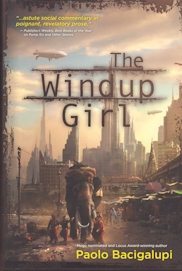
cover of The Windup GirlThe biggest problem with this year's best novel category is that there is only one rocket to go around. I like to see the Hugo Award go to a novel that is unique and memorable and thought-provoking and superbly written. Three of this year's nominees, the Bacigalupi, Miéville, and Valente novels, meet those criteria for me.

Out of a very strong field, my #1 choice is The Windup Girl by Paolo Bacigalupi. Bacigalupi is only the third author of the past 25 years to see his first novel nominated for both the Hugo and Nebula Awards, and The Windup Girl is just the sort of once-in-a-generation reading experience that suggests. The novel combines an absorbing story with one of the most fascinating settings I've ever encountered, Bacigalupi's vision of future Thailand. Paolo Bacigalupi will be one of the leading voices of the SF field (and all of literature) for as long as he wants to be. A Hugo Award would be a great way to urge him on to a very long writing career.

China Miéville's The City and the City also features a tremendously inventive setting, the coexisting cities of Beszel and Ul Qoma. The way the inhabitants of both cities learn to unsee one another is fascinating and a powerful metaphor for how people manage to train themselves to avoid facing what is right in front of them. I enjoyed this novel throughout, even though the murder mystery plot is not entirely successful.

Catherynne M. Valente writes in a lush, ornate style that I would detest, except that she does it so exceedingly well. Palimpsest is a beautifully written novel, with striking imagery and a great deal to say about love and sex and the barriers that separate all of us. Valente is one of the very best authors in our field, and I am delighted Palimpsest received a Hugo nomination.

For me, whether I enjoy Robert J. Sawyer's work usually turns on if the ideas of a particular book are interesting enough to overcome the clunky writing. The ideas in WWW: Wake, including a blind woman gaining sight as she encounters an emerging intelligence existing in the Internet, would be strong enough to pass that test but they didn't have to, for I didn't find the writing of WWW: Wake clunky at all. In particular, I would not have thought Sawyer up to the challenge of conveying what it might be like for a blind person to gain eyesight for the first time, yet I found those passages in this novel very powerful and moving. Still, Sawyer can't quite compete with Paolo and China and Cat.

I enjoyed Cherie Priest's Boneshaker, a steampunk zombie adventure that has a lot more going for it than that gimmicky hook might suggest. As described in more detail in my review, Boneshaker is most entertaining, even if not tightly written, but does not compare favorably with the other outstanding works in this category. The same is true for me of Robert Charles Wilson's Julian Comstock, about which I will say nothing more, because I must confess the novel didn't catch my interest enough for me to finish reading it.

With the range and quality of works on this ballot, this is an exciting time to be a science fiction and fantasy reader. I wish I were down under right now, to see one of these outstanding authors receive his or her well-earned recognition.

Aaron's Ballot for Best Novel
1. Paolo Bacigalupi - The Windup Girl
2. China Miéville - The City and the City
3. Catherynne M. Valente - Palimpsest
4. Robert J. Sawyer - WWW: Wake
5. Cherie Priest - Boneshaker
6. Robert Charles Wilson - Julian Comstock

Aaron's Take on the 2010 Hugo Nominees :: DRAMATIC PRESENTATION, LONG FORM

The Hugo Awards are only a few hours away, which makes this my absolute last chance to declare in advance (barely) what should win, rather than whining about what should have won.

One of the most closely followed categories is Dramatic Presentation, Long Form (i.e., SF movies), even though the creators of the nominees often couldn't care less about the Hugo Awards. More to the point, the nominees often suck.

This year, however, we have a very strong slate of nominees, nearly rivaling the 1983 ballot, which included such classics as Blade Runner, Star Trek II: The Wrath of Khan and E.T. In many a year, District 9 would be my hands-down first choice for the dramatic presentation Hugo, but this year I had to stick it down at #4 on my ballot, in favor of even better films.

Before we get to all that good stuff, however, let's dispose of the one nominee I disliked, the 2009 version of Star Trek. I acknowledge that this movie was entertaining, but I just hated it, largely because I am a big fan of the original Star Trek series. And this movie is emphatically not Star Trek. The one-dimensional characters: not Star Trek. (Compare the moronic Romulan villain in this movie to the Romulan commander in the "Balance of Terror" episode.) The ridiculous woo-woo science: not Star Trek. The cartoonish visuals: not Star Trek. The huge water pipe in the Enterprise's engineering section, the lack of handrails on the Romulan ship (plus knee-deep water--apparently it had one of those huge pipes too, and it froze), the fistfights and swordfights between characters who are carrying phasers, all of that would be at home in a Star Wars prequel or maybe Galaxy Quest but please don't call it Star Trek. The sad thing is most of this could have been fixed with a few lines of dialogue here and there, but the makers of this film didn't care enough to bother. This film is an old-style Hollywood assault on its viewers' intelligence, as bad as any 1950's black-and-white skiffy you can find.

With that rant out of the way, let's get to all the good news. I enjoyed District 9, an intelligent film with something to say about race and class barriers. The film had an interesting look, juxtaposing all-too-familiar slum areas with the visually striking alien creatures. But the movie can't make up its mind whether it wants to pretend to be a documentary——too much of the footage obviously would not have been available to the hypothetical documentary filmmakers——and I think it was a mistake to make the main character such a twit at the outset.

Up is another delightful success from Pixar. The movie features a grumpy old man protagonist and pulls it off remarkably well. And hearing the dogs' thoughts——"I will go get the ball!!! And then I will bring it back!!!"——was worth the price of admission by itself.

Moon is a cleverly written film, with some memorable twists. Sam Rockwell gives an unforgettable performance. The slow pace and grand visuals (despite the low budget) are a marvelous tribute to a prior generation of movies such as 2001 and Silent Running. I especially like the way the GERTY emerges as sort of a converse of HAL from 2001. This is a terrific movie, and I will be happy if it wins the Hugo, even though it is not my #1 choice.

My top choice is the highest-grossing film ever, Avatar. This movie is 37 different kinds of awesome, and I can't believe how blasé many fans of SF literature are about it. Some complain that the film is a rip-off of Ursula K. LeGuin's The Word for World Is Forest and Poul Anderson's "Call Me Joe." But to me, for Hollywood to draw inspiration from Ursula LeGuin or Poul Anderson is a very good thing. This film is visually stunning but also intelligent. The storyline may be fairly standard and straightforward, but the movie treats it with enough respect that it works. I can't remember when I last enjoyed a movie this much, and I hope the Hugo voters were not too snobbish to give Avatar the recognition it deserves.

Aaron's Ballot for Best Dramatic Presentation, Long Form
1. Avatar
2. Moon
3. Up
4. District 9
5. Star Trek

Monday, July 19, 2010

Aaron's Take on the 2010 Hugo Nominees :: NOVELETTES

Eros, Philia, AgapeBest novelette is the most difficult category for me to rank this year. I find three of the nominees outstanding——the Eugie Foster, Rachel Swirsky, and Peter Watts stories——and have trouble selecting between them. The good news is I will be happy if any of them wins the award.

After much deliberation, my top ranking goes to Rachel Swirsky's "Eros, Philia, Agape." It is arguably not quite so ambitious as the Foster and Watts stories, but the execution is flawless. The protagonist of "Eros, Philia, Agape" acquires a male robot programmed to develop a personality that conforms to all her desires, yet somehow this proves not enough for a lasting relationship. I recommended this story when it first appeared, and I stand by my assessment that it is a wonderfully subtle meditation on universal issues about identity and love and marriage and family and parenting.

My second choice by the narrowest of margins is "Sinner, Baker, Fabulist, Priest; Red Mask, Black Mask, Gentleman, Beast" by Eugie Foster. This is a beautifully written story built on an intriguing premise, a world where each person puts on a different mask every morning and subsumes herself within the role that mask represents. The whole society is thus comprised of individuals lacking, or at least unaware of, individual personalities. Not surprisingly, our protagonist(s) ends up questioning this way of life, but Foster's resolution of the story was not entirely satisfying to me.

"The Island" by Peter Watts is perhaps the most intellectually fascinating of the nominees, combining a provocative first contact scenario with the politics on a starship engaged in an eons-long journey to construct wormholes for interstellar travel. But it didn't grab me emotionally as the Swirsky and Foster stories did. Watts is not entirely successful at conveying his protagonist's despair, and he waits far too long to reveal important things that she knew or should have known much earlier.

"Overtime" by Charles Stross is a Christmas entry in Stross' Laundry series, in which superspies battle Lovecraftian horrors despite the constraints of their Dilbertesque bureaucracy. Their high tech office includes, for instance, a rotary phone, because "the NDO's office budget was misfiled years ago and nobody knows the correct code to requisition new supplies." This is an entertaining story that does everything it sets out to do, but is just not as memorable as the previous three nominees.

Nicola Griffith's "It Takes Two" is an engrossing story. Griffith does a wonderful job of putting the reader into the skin of a woman falling in love. Add to that the tension from the reader's suspicion that something is not right about this love affair, and the first half of the story works very well. Unfortunately, we then find out what's not right, and the story abruptly stops working. There is no believable reason for the protagonist to have agreed to the elaborate procedure described, and her stated reason for agreeing (she didn't want to feel uncomfortable going to a strip club) is so flat-out preposterous that the whole story falls to pieces.

Finally, Paul Cornell's "One of Our Bastards Is Missing" is an inoffensive SF locked room mystery, involving a strange disappearance at the wedding of a British princess. There is nothing wrong with this story but neither is there anything award-worthy about it. I can only assume it made the ballot thanks to a certain segment of fans (you know the ones——they talk funny and they nominated every eligible episode of Doctor Who) who are fascinated with the royal family.

Aaron's Ballot for Best Novelette
1. Rachel Swirsky - Eros, Philia, Agape
2. Eugie Foster - Sinner, Baker, Fabulist, Priest; Red Mask, Black Mask, Gentleman, Beast
3. Peter Watts - The Island
4. Charles Stross - Overtime
5. Nicola Griffith - It Takes Two
6. Paul Cornell - One of Our Bastards Is Missing

Sunday, July 18, 2010

Aaron's Take on the 2010 Hugo Nominees :: DRAMATIC PRESENTATION, SHORT FORM

A grassroots effort to turn the Dramatic Presentation, Short Form category into "Best Doctor Who Episode" was thwarted by the fact that only three Doctor Who episodes were released last year. I'm not sure it was necessary to nominate all three, but at least they are good examples of the form, and the two non-Doctor nominees are strong enough to make this a solid list overall.

Let's dispose of the Doctor first. To my tastes the best of the three nominated episodes is "The Waters of Mars," in which the Doctor encounters a body-snatching alien life form. Its appearance comes at a critical moment in history, and for once the Doctor is convinced he should not interfere. His frustration at being unable to help lends an effective "Cold Equations" feel to the episode, and it is appropriate that the action he finally takes does not turn out as intended.

"The Next Doctor" is also a strong episode. The identity of the "next doctor" makes a nice mystery, although Russell Davies made the right choice in not waiting until the end of the show to reveal the answer. The episode has some strong dramatic moments, despite a disjointed story and the actors hamming it up in typical Who fashion. The King of the Cybermen strolling through 1850's London is an effective ending image, but then Doctor Who was doing steampunk long before it was cool.

Less successful is "Planet of the Dead," which features a nonsensical plot, beginning with perhaps the most egregious example yet of the Doctor just happening to be there when bizarre stuff happens——naturally, he'll be riding the one bus in the history of London to be pulled through a wormhole——and ending with no explanation of why this swarm of nasty critters should open a wormhole to attack Earth but then wait exactly as long as the Doctor required before trying to zip through the hole. Meanwhile, the interaction between the Doctor and wannabe companion Lady de Souza feels forced.

"No More Good Days," the premier episode of FlashForward, combines an interesting premise (thanks to Robert Saywer) with good acting and nice effects. David Goyer's direction is intrusive at times, for example circling the camera around conversing characters until the viewer's head swims, but by the end he managed to build up the tension nicely. This was a solid opener to the series, but we have learned recently that Hollywood TV introduces SF plotlines far better than it resolves them.

By far my favorite of the nominees is "Epitaph One," the made-for-DVD final episode of Season One of Dollhouse. I watched Dollhouse from the outset, and like many viewers I felt the show got off to a slow start and was borderline offensive in its easy acceptance of the deeply immoral technology involved, which it treated initially as just a fun way to produce great prostitutes. Thankfully, by the end of Season One Joss Whedon made it clear that the main storyline would be Echo's struggle to retain her identity and defeat the evil minds behind the Dollhouse. "Epitaph One" showed us how much is at stake, with a glimpse of a future where Dollhouse technology has destroyed civilization. I found the episode gripping in itself, and also a huge step forward for the show, although the second season did not quite deliver on that promise.

Incidentally, because the character of Echo is offstage through nearly all of "Epitaph One," Eliza Dushku's detractors may vote for it with a clear conscience. I'm actually of the minority view that Dushku's acting was a strength of Dollhouse. She was not entirely convincing in all of the different roles Echo assumed, but then it was important to the show that she not be entirely convincing. However Echo was imprinted, we needed to see flashes of the same core personality, a core personality that was confused and uncertain. Perhaps this is a case like William Shatner in the original Star Trek, where an actor's flaws are happily well-suited to the character (I haven't seen enough of Dushku's work to say), but I thought she pulled that off perfectly.

"Epitaph One" was the strongest episode of a show that, despite its flaws, was the best SF on television in 2009.

Aaron's Ballot for Best Dramatic Presentation, Short Form
1. Dollhouse, "Epitaph One"
2. Doctor Who, "The Waters of Mars"
3. FlashForward, "No More Good Days"
4. Doctor Who, "The Next Doctor"
5. Doctor Who, "Planet of the Dead"

Thursday, July 08, 2010

Aaron's Take on the 2010 Hugo Nominees :: GRAPHIC NOVELS


I am no expert on graphic novels, but the point of including this category in the Hugo Awards is to highlight graphic works that should appeal to readers of prose science fiction and fantasy. So as a devoted SF/F prose reader, here is my take on the graphic novel (er, "graphic story") Hugo nominees.

By far the strongest of the five nominees to me is Batman: Whatever Happened to the Caped Crusader? This is a wonderful tribute to the character of Batman, a fitting end to DC's run of sequentially numbered Batman comic books. I'm sure to a long-time Batman fan the tribute comes across even more powerfully, as Neil Gaiman and Andy Kubert have deliberately patterned sections of the story after various Batman creators of old. Even ignoring how this volume riffs on the history of Batman, it is a delightful book for its meditation on the significance of any old, oft-repeated tale. It is such a beautifully written story, I suspect most fans could identify it as the work of Neil Gaiman even if his name were left off the cover.

One reason I don't read more graphic novels is that I have long since tired of the superhero concept, in just the way I have tired of vampire stories. So there could hardly be a worse combination for me than Captain Britain and MI13: Vampire State, a graphic novel in which a group of superheroes battle Dracula and other vampires. Yet I found it impossible not to enjoy this book. Writer Paul Cornell crafted a strong storyline with many nice touches, such as the opening image of Dracula on the moon, dragging his boot across Neil Armstrong's footprint. I love how Cornell conveys the characters' Britishness, even including a long flashback to a superheroes' game of cricket. The tale is easy enough to follow despite the large extent of backstory built in, and the artwork by Leonard Kirk and several others is wonderfully vivid.

By all reports, and judging by its multiple Eisner Awards, Bill Willingham's Fables, peopled by a huge cast of reimagined storybook characters, has been one of the most inventive series of the past several years. After several books focused on the struggle against the "Adversary," the current Hugo nominee, Volume 12: The Dark Ages, begins a different story arc and introduces a new villain. This volume is somewhat lacking in drama, since the new conflict remains far from resolution by the end, but there are still plenty of clever moments. I particularly enjoyed the appearance of Fritz Leiber's characters Fafhrd and the Gray Mouser.

The highlight of Girl Genius: Agatha Heterodyne and the Heirs of the Storm is the striking artwork by Phil Foglio (with lush colors by Cheyenne Wright). It's a good thing the book has such strong visual appeal, because the story ranges from jumbled to incoherent. I'm at a disadvantage for not having read all the previous volumes, but I'm hard pressed to see how anyone could care about the dense layers of background information that come into play. The humor is hit-or-miss, for me more miss than hit, although I admit I laughed out loud a couple times. A final strike against this is the abrupt "to-be-continued" ending.

Howard Tayler's Schlock Mercenary is a long-running webcomic, done in the newspaper style, with a punchline at the end of each strip. Like most comic strips, I find the humor erratic. (The only daily comics that ever struck me as consistently funny were Bloom County and Calvin and Hobbes, so my standards are admittedly rather high.) While the volume of Schlock Mercenary nominated for last year's Hugo Award had some funny moments, I'm sorry to say the new edition, subtitled The Longshoreman of the Apocalypse, did not make me laugh. That doesn't leave much to hold interest, for the story is routine at best (our mercenary heroes deliver a shipment of food to a space station) and takes far too long to develop.

Aaron's Ballot for Best Graphic Story
1. Neil Gaiman, Andy Kubert & Scott Williams - Batman: Whatever Happened to the Caped Crusader?
2. Paul Cornell, Leonard Kirk & Mike Collins, et al. - Captain Britain and MI13: Vampire State
3. Bill Willingham & Mark Buckingham, et al. - Fables: The Dark Ages
4. Kaja & Phil Foglio & Cheyenne Wright - Girl Genius: Agatha Heterodyne and the Heirs of the Storm
5. Howard Tayler - Schlock Mercenary: The Longshoreman of the Apocalypse

Wednesday, June 30, 2010

Aaron's Take on the 2010 Hugo Nominees :: NOVELLAS

cover of The God EnginesBest novella is a strong category this year. Even though this is certainly the fiction category with the fewest eligible works published, the voters managed to find six worthy nominees. All of the nominees will have their supporters——several of the nominated authors are popular with the Hugo voters, plus Kage Baker will have a sympathy vote due to her untimely death——but my guess is John Scalzi will win a Hugo for the third straight year, his first in a fiction category.

Kage Baker's "The Women of Nell Gwynne's," a steampunk mystery with a group of prostitute/spies as lead characters, is mostly light entertainment but does have an appropriately dark edge when showing us why some of our heroines would choose this life. The tale features some wonderful dialogue and is great fun to read, but the whodunit does not satisfy and the story feels less complete than the other nominees. My guess is "The Women of Nell Gwynne's" was meant as the first in a series of stories about these remarkable ladies——see for instance my recommendation for The Bohemian Astrobleme——which sadly will now never be completed.

"Palimpsest" by Charles Stross is a time travel story on a very large scale. While it begins with the cliché of a time traveler killing his own grandfather, the tale quickly moves on to grander and more original issues about the fate of humanity over the next billions, even trillions, of years. The folks directing human destiny control time travel technology, although oddly their grand plans mostly involve moving planets around, not time travel. Stross throws plenty of interesting ideas at us, but fails to include strong enough characters to provide the emotional hook to carry us through this type of Stapledonian epic. The main character has very little personality, and his two girlfriends have none at all.

"Act One" by Nancy Kress, a former story recommendation of the week, explores the morality of an attempt to impose genetic modifications on humanity to give everyone a greater sense of empathy. This is a near-future story on a much smaller scale than "Palimpsest," but the superior characterization makes "Act One" more successful overall.

James Morrow is the best satirist in our field, and one of the two best ever along with John Sladek. "Shambling Towards Hiroshima" exemplifies his trademark dry humor. The protagonist is a Boris Karloff-style creature-feature actor, called on during World War II to give the Japanese a demonstation of the damage that will be inflicted, if they don't surrender, by a fearsome weapon the United States has developed: monstrous fire-breathing lizards. Morrow has great fun writing of the B-movie culture of 1940's Hollywood, but he doesn't quite manage to combine this with his serious point as seamlessly as in his best work. The goofy monster movie material takes over the story, while the endnote as to the morality of weapons of mass destruction feels tacked on.

Ian McDonald's "Vishnu at the Cat Circus" is the fascinating life story of a genetically engineered slow-aging super-genius who was instrumental, along with his unmodified brother, in the radical transformation of India. In contrast to "The Women of Nell Gwynne's," which suffered because it felt like the opening chapter of a larger unfinished work, "Vishnu at the Cat Circus" is impressive because it stands alone very well yet also is a terrific capstone to Ian McDonald's series of stories (as well as the novel River of Gods) set in a future India.

While all the nominees in this category are very good, my favorite is John Scalzi's "The God Engines," the thought-provoking story of Ean Tephe, captain of a starship powered by an enslaved god, captured and harnessed by the god Tephe worships. Not surprisingly, Tephe comes to doubt his faith in his own god, but from there matters do not play out as you might expect. The tale is an interesting blend of science fiction, fantasy, and horror elements.

John Scalzi has emerged in the past five years as one of the field's most capable authors, but at times he relies too heavily on snappy dialogue, rather than attempting something with more depth and emotional impact. "The God Engines" is thus a breakthrough work for him. Scalzi sets aside his usual sardonic humor in favor of original, intricate world-building and a compelling protagonist caught in the teeth of a dilemma from which there may be no way out. All of Scalzi's fiction is entertaining, but "The God Engines" is his best yet.

Aaron's Ballot for Best Novella
1. John Scalzi - The God Engines
2. Ian McDonald - Vishnu at the Cat Circus
3. James Morrow - Shambling Towards Hiroshima
4. Nancy Kress - Act One
5. Charles Stross - Palimpsest
6. Kage Baker - The Women of Nell Gwynne's

Thursday, June 10, 2010

Book Review Teaser :: Boneshaker by Cherie Priest

cover of BoneshakerNew on Fantastic Reviews is Aaron's review of Boneshaker by Cherie Priest. This book is one of the current 2010 Hugo award nominees for Best Novel.

From Aaron's book review of Boneshaker :
"Boneshaker is a steampunk zombie novel, but much less gimmicky and more accomplished than this label suggests...."

"Boneshaker is set in Seattle circa 1880, but a steampunk alternate version of Seattle largely destroyed when Dr. Leviticus Blue's massive "boneshaker" drill undermined the city's foundations while simultaneously releasing a lethal subterranean gas that renders its victims zombies. Blue was never heard from again after the disaster, but his wife Briar Wilkes and son Zeke - unborn when Blue disappeared but now fifteen years old - scratch out a living in the outskirts of the ruined city, outside the immense walls that hold in the gas blight and zombies"

"Convinced history has treated his father unfairly, Zeke puts on a gas mask and follows an underground tunnel into the city on a quest to clear Leviticus Blue's name. With impeccable teenager logic, he braves the city alone, without telling his mother of his plans. The story begins in earnest...when an earthquake collapses the tunnel, and Briar sets out to rescue Zeke by airship...."

To read the entire review -> Boneshaker

Wednesday, May 12, 2010

Aaron's Take on the 2010 Hugo Nominees :: PROFESSIONAL ARTISTS

cover of Always ForeverThe five Hugo-nominated professional artists are all outstanding, each in his own way, and we are blessed to have artistic talent like theirs in our field. I don't have the expertise to evaluate the artists' relative degrees of craft and technique, but I can say whose work most catches my attention and most rewards repeat examinations, whose cover art makes me want to read the book just so I can carry that gorgeous cover around.

The two artists who consistently draw that reaction from me are Stephan Martiniere and John Picacio. As much I love every Martiniere cover, I will have to rank Picacio #1 this year, because 2009 saw some of his most striking work yet. Let me call particular attention to his covers for Mark Chadbourn's Age of Misrule series, from Pyr Books (which never disappoints with its cover art). The covers are beautiful individually, but even more memorable for their progression through the series, from the torso of the immense mythical creature on the cover of World's End (dwarfing our heroes in the foreground) to the head on Darkest Hour to finally the Sauron-esque eye on Always Forever. Amazing stuff!

This should take nothing away from the other excellent nominees. Shaun Tan's Tales from Outer Suburbia is a terrific showcase of his work, even if it suffers a bit by unfair comparison to his wonderful book The Arrival from 2007. I hate to put Bob Eggleton all the way down at #4, as he has been one of the most reliable artists in the field for many years, but then again he already has nine Hugo Awards to show for that body of work. Daniel Dos Santos is also very good, although his style is slightly less to my tastes than the other nominees. Suffice to say that whoever wins the award will be a very worthy recipient.

Aaron's Ballot for Best Professional Artist
1. John Picacio
2. Stephan Martiniere
3. Shaun Tan
4. Bob Eggleton
5. Daniel Dos Santos

Wednesday, April 07, 2010

Aaron's Take on the 2010 Hugo Nominees :: SHORT STORIES

Short stories are often my least favorite of the Hugo fiction categories, but this year's slate has a good ratio of two excellent stories (one that I nominated and one I would have if I had read it in time), two good ones, and one lousy one.

My top choice is "Spar" by Kij Johnson, about a woman who escapes a spacewreck in a lifeboat shared by an amoeboid alien, with whom she cannot communicate except to engage in sexual intercourse. The opening line is, "In the tiny lifeboat, she and the alien fuck endlessly, relentlessly." Kij Johnson is usually an elegant writer, but this story is deliberately harsh. "Spar" is not an enjoyable reading experience, but it is a powerful, memorable story. It has important things to say about gender issues and sexual politics, concepts Johnson could not convey without the SFnal premise. I suspect I will still have strong recollections of "Spar" decades from now, that it will still be coming up in conversation. That is the kind of story I like to see win a Hugo Award.

I read most of the January 2009 issue of Asimov's when it came out, but I skipped "Bridesicle" by Will McIntosh, because the story idea sounded unpromising: young women who have died are kept frozen, in hopes that a rich man will come along to pay for the expensive procedure to revive them, in the future's version of mail-order brides. But McIntosh adds a crucial additional element, that another option for a dying person is to preserve his or her identity in the mind of a survivor. Our protagonist Mira is a frozen potential bride, who previously held her mother's personality, but it was lost when Mira died, to her guilty relief. To be resurrected, Mira must hope to marry a rich older man, even though she is gay, which makes the whole set-up a metaphor for societal barriers against gays. These different elements combine together nicely into a very strong story.

In "The Bride of Frankenstein," Mike Resnick similarly writes of a bride in unusual circumstances. The story is a humorous take on the Frankenstein story, told from the point of view of Victor Frankenstein's bitchy, modern wife, who doesn't understand why he's squandering her stock portfolio for experiments on a hideous creature. Resnick takes the tale in a romantic direction I found quite charming.

N.K. Jemisin's "Non-Zero Probabilities" is a well-crafted story, which finds an optimistic take on a daunting premise, basically that Murphy's Law has taken utter control of Manhattan. When the Hugo nominations came out, I started to read this, was quite enjoying it, and got well into the story before realizing that I already read it last year. So this is an enjoyable but not at all memorable story, completely the reverse of "Spar." The good news for Jemisin is now I recall why I picked up that copy of The Hundred Thousand Kingdoms sitting in my to-read pile.

Last and by far least is "The Moment" by Lawrence M. Schoen, a dreadful piece that has no business on a Hugo ballot. The story is about aliens visiting Neil Armstrong's footprint on the moon, but you can't give Schoen credit for that mildly clever idea -- it was written for a theme anthology of stories about aliens visiting the astronauts' footprints on the moon. "The Moment" is a hopeless jumble of sentences like, "The generation ship of Krenn frantically dumped velocity as it splooched from the fuel-efficient but mind-numbing slowness of intramolecular phasetransit back into the normal time-space continuum, less than a cubit above the moon." Perhaps this is meant as a tongue-in-cheek send-up of really bad pulp-era skiffy, but it is that only in the sense that "The Moment" is itself really bad pulp-style skiffy. I actually wrote a long rant for this blog chastising whoever stuffed this turkey onto the ballot, but I think I won't publish it. I googled around and while I can't find much praise for this story, I also don't see that others have disliked it as much as I did. Rich Horton has called it "interesting" and "worth reading," so maybe I missed some redeeming quality.

Aaron's Ballot for Best Short Story
1. Kij Johnson - Spar
2. Will McIntosh - Bridesicle
3. Mike Resnick - The Bride of Frankenstein
4. N.K. Jemisin - Non-Zero Probabilities
5. NO AWARD
6. Lawrence M. Schoen - The Moment

Thursday, February 25, 2010

Aaron's Story Recommendation of the Week :: Sinner, Baker, Fabulist, Priest; Red Mask, Black Mask, Gentleman, Beast by Eugie Foster

Interzone JanFeb 2009This week's story recommendation is "Sinner, Baker, Fabulist, Priest; Red Mask, Black Mask, Gentleman, Beast" by Eugie Foster, a novelette from the January/February 2009 issue of Interzone, reprinted here in the August 2009 issue of Apex Magazine. This is Foster's second SROTW, joining Paolo Bacigalupi, Catherynne M. Valente, Aliette de Bodard, and Leah Bobet as two-time recommendees. Perhaps even more significantly, "Sinner, Baker, Fabulist, Priest; Red Mask, Black Mask, Gentleman, Beast" was nominated last week for the Nebula Award.

"Sinner, Baker, Fabulist, Priest; Red Mask, Black Mask, Gentleman, Beast" is set in a world whose residents don a different mask each morning, abandoning their individual personalities (a concept utterly foreign to them) in favor of the role represented by that day's mask. Perhaps inevitably, our viewpoint character(s) encounters a person who challenges this way of life.

A story with a premise like this can easily be swallowed by its own metaphors, but Foster manages to keep the tale moving forward, using elegant but not flashy prose. This is a fascinating, absorbing story, even if I have mixed feelings about the resolution, and I will certainly be including it in my Hugo Award ballot.

Wednesday, December 23, 2009

Aaron's Story Recommendation of the Week :: Advertising at the End of the World by Keffy R.M. Kehrli

I am back to reading short fiction, and my story recommendation for this week is Advertising at the End of the World by Keffy R.M. Kehrli, from the September 2009 issue of Apex Magazine.

"Advertising at the End of the World" begins with perhaps the best opening line I have seen this year:
Five years after her husband died, two years after she moved to a cabin in Montana, and six months after the world ended, Marie opened her curtains to discover her front garden overrun with roving, stumbling advertisements.
The "advertisements" are programmed humanoids, determined to keep pitching the products of vendors long since wiped out by plague. The initial image of walking advertisements mindlessly tromping through survivor Marie's flower garden has a whimsical feel, but Kehrli soon turns the story in a wistful direction, as the advertisements remind Marie of everything she has lost.

Keffy Kehrli only began selling fiction in early 2009, but he has already published stories in Apex, Talebones, and Sybil's Garage, with more forthcoming in Electric Velocipede and Fantasy. Apex, a print magazine turned top-notch e-zine, is notable for publishing up-and-coming authors like Ekaterina Sedia, Theodora Goss, Lavie Tidhar, Eugie Foster, Jennifer Pelland, and Aliette de Bodard. If "Advertising at the End of the World" is any indication, Keffy Kehrli belongs among such company.

Friday, November 06, 2009

Amy's bookshelf :: Unclean Spirits by M.L.N. Hanover

Unclean SpiritsThis week's featured book is Unclean Spirits by M.L.N. Hanover, book one of The Black Sun's Daughter series. The paperback's cover, showing a leather-clad woman with a tattoo on her back and a sharp weapon in her hand, proclaims that this is another urban fantasy. But what makes this book different, and what grabbed my attention (in addition to Denver being mentioned in the back cover blurb) is that Unclean Spirits was written by Daniel Abraham, author of the excellent fantasy The Long Price Quartet: A Shadow in Summer, A Betrayal in Winter, An Autumn War, and The Price of Spring. (You can see Aaron's positive review of A Shadow in Summer on Fantastic Reviews ).

I bought Unclean Spirits a couple weeks ago at MileHiCon. Daniel Abraham was one of the authors attending the SF convention this year and I asked him to autograph the book. Apparently this copy of Unclean Spirits was already signed by "M.L.N. Hanover", but Daniel Abraham kindly added his signature below that of his pseudonym.

Monday, October 05, 2009

Aaron's Story Recommendation of the Week :: Her Eyes Like Sky, and Coal, and Moonlight by Cat Rambo

Eyes Like Sky and Coal and MoonlightMy story recommendation for this week is "Her Eyes Like Sky, and Coal, and Moonlight" by Cat Rambo, the (almost) title story of Rambo's new collection Eyes Like Sky and Coal and Moonlight, from small publisher Paper Golem, with gorgeous cover art by Carrie Ann Baade.

"Her Eyes Like Sky, and Coal, and Moonlight" is a beautifully constructed story, telling in hindsight of the battles for control of a war-torn kingdom, as glimpsed from the point of view of a young (at first) woman whose family's inn is an occasional meeting place of a group of rebels. The rebels include the enigmatic sorceress whose haunting eyes lend the story its poetic title.

The rebels' struggle defines our narrator's life, even though she sees almost none of the action take place. The danger in such a story is the reader may feel disappointed that the most interesting events are occurring offstage, but Rambo tells it in a way that suggests this is the real story, that the battles of great kings and warriors and wizards are important only for how they affect the lives of common folk.

"Her Eyes Like Sky, and Coal, and Moonlight" is quite short, like most of Cat Rambo's work -- only a few of the stories in Eyes Like Sky and Coal and Moonlight are over ten pages and none over twenty. Usually it is difficult to create a compelling tale in so few words, but Rambo is superb at providing a sense of depth, making you feel there is more to the story and characters, that you could fill in much of the rest of the story yourself from the hints she drops.

I'll try to get a review of the whole book up at Fantastic Reviews before too long, but for now I'll just say that Eyes Like Sky and Coal and Moonlight is an excellent collection by a most elegant writer.

Friday, September 11, 2009

Aaron's Story Recommendation of the Week :: Placa del Fuego by Tobias S. Buckell

Inspired by Lev Grossman's controversial article denouncing plot-free modernist fiction, the story recommendation for the week is a very entertaining planetary adventure, Placa del Fuego by Tobias S. Buckell, from the July 2009 issue of Clarkesworld.

Set on the same harsh world as Buckell's novel Sly Mongoose, "Placa del Fuego" follows young pickpocket Tiago as he confronts in quick succession a powerful android, a resourceful female crime overlord, and a vicious alien beast. Typical of Buckell's fiction, the story is fast-paced and high-octane, yet also slips in some food for thought. In particular, "Placa del Fuego" raises the question whether the idea of free will has any meaning to someone as downtrodden as Tiago.

Tobias S. Buckell's related novels Crystal Rain, Ragamuffin, and Sly Mongoose were all well received, but "Placa del Fuego" demonstrates that his style also works well at shorter lengths. You can find most of his short fiction to date in Tides from the New Worlds from Wyrm Publishing.

Tuesday, August 25, 2009

Aaron's Story Recommendation of the Week :: The Wide, Carnivorous Sky by John Langan

By Blood We LiveThe story recommendation of the week is "The Wide, Carnivorous Sky" by John Langan, an original novella from the vampire anthology By Blood We Live, edited by John Joseph Adams.

By Blood We Live is mostly a reprint anthology, with just two original pieces, but they are two good ones, "The Wide, Carnivorous Sky" and "Foxtrot at High Noon" by popular Russian author Sergei Lukyanenko. While the other tales are reprints, they come from a remarkable array of talented authors and John Joseph Adams has drawn from quite diverse sources. (I had only read one of the 33 stories before, Stephen King's "One for the Road.") Themed anthologies can sometimes become tiresome but -- as he did in his anthologies Seeds of Change, Wastelands, The Living Dead, and Federations -- Adams avoids that pitfall by his knack for combining excellent stories with varied approaches to the theme.

"The Wide, Carnivorous Sky" is a great example, putting a memorable spin on the vampire legend. A group of American veterans first encountered the creature at the heart of the story while in the midst of combat in Iraq, and have since been plagued by a strange telepathic connection with it. The thing drinks blood and has the other key traits of vampires, but oddly inverted or distorted, for example it can only emerge in daylight and the soldiers believe it sleeps in an orbital chrysalis.

The best horror fiction creates a sense of dread from everyday sights and sounds. By having his monster appear out of an open sky and return to a lair above our heads, Langan manages to make the sky itself a source of dread:
Davis had stared at the sky before--who has not?--but, helpless on his back, his spine a length of molten steel, his ears full of Manfred whimpering that he was gonna die, oh sweet Jesus, he was gonna fucking die, the lieutenant talking over him, insisting no he wasn't, he was gonna be fine, it was just a little paper cut, the washed blue bowl overhead seemed less sheltering canopy and more endless depth, a gullet over which he had the sickening sensation of dangling. As Manfred's cries diminished and the lieutenant told--ordered him to stay with him, Davis flailed his arms at the ground to either side of him in an effort to grip onto an anchor, something that would keep him from hurtling into that blue abyss.
John Langan's first novel House of Windows is forthcoming from Night Shade Books, and his collection Mr. Gaunt and Other Uneasy Encounters was a Stoker Award nominee this year. Look for "The Wide, Carnivorous Sky" on horror award shortlists next year.

Sunday, August 16, 2009

Aaron's Story Recommendation of the Week :: The Wedding Gift by Jacqueline West

The Wedding GiftMy story recommendation this week is "The Wedding Gift" by Jacqueline West, from the June 2009 issue of Ideomancer.

I loves me a good ghost story, and for me the key is a light touch by the storyteller. "The Wedding Gift" is a ghost story, but Jacqueline West tells it with great subtlety. The tale builds tension quickly, even though no supernatural element ever appears but for some strangely behaving birds. Equally subtle is the characterization, delicately hinting that our protagonist Drina's relationships with her cold fiancé and her well-meaning but domineering grandmother have left her vulnerable to the visitation that occurs.

Jacqueline West has published over three dozen poems, including two Puschcart Prize nominees, but only six pieces of short fiction to date; here's hoping there is much more to come from her. Ideomancer has been around since 2002, publishing such excellent authors as Christopher Barzak, Samantha Henderson, Ted Kosmatka, Yoon Ha Lee, Sarah Monette, Ruth Nestvold, M. Rickert, Rachel Swirsky, and Greg van Eekhout. Leah Bobet is editor and has taken the reins as publisher this year, by all indications without missing a beat.

Monday, August 10, 2009

Aaron's Story Recommendation of the Week :: Blighted Heart by Aliette de Bodard

Blighted HeartThis week's story recommendation is "Blighted Heart" by Aliette de Bodard, from Issue #22 (July 30, 2009) of e-zine Beneath Ceaseless Skies (cover art by David Renn).

"For years my city gave the hearts of maidens to the corn-man to awaken him," the story begins. Our narrator is Metlicue, chosen for this sacrifice by the village priests, who proceed unaware that in defiance she gave her virginity to a soldier the night before:
I felt the first cut like a violation. Pain burst in my chest, would not cease. I screamed and screamed until my voice was raw. No. No. I never asked for this! I saw a priest lift out a bloody, pulsating thing dizzyingly high above me, and a sensation of emptiness spread from the hole in my chest and swallowed me.

The priests placed my heart, still beating, in the mouth of the effigy. One of them spoke the healing spells over me. I rose, shaking, numb all over, stared at the corn-man.

His eyes opened.
Metlicue is left without a heart, her emptiness a wonderful metaphor for the alienation felt by those who have been molested or traumatized, but the story only builds from there. For Metlicue's act of defiance has in turn destroyed the innocence of the corn-man, on whom her people depend for good fortune and plentiful harvests, and Metlicue will have to face him again. "Blighted Heart" is a powerful, beautifully written story, and a great example of why de Bodard was the runner-up for this year's John W. Campbell Award for Best New Writer, losing out very narrowly to David Anthony Durham.

Beneath Ceaseless Skies hasn't gotten a lot of attention yet, but it has been publishing some excellent authors, such as David D. Levine, Yoon Ha Lee, Marie Brennan, Holly Phillips, Stephanie Burgis, Richard Parks, among many others. It pays professional rates, has held strictly to its publishing schedule (a two-story issue every other week) for nearly a year, and provides audio versions of many of its stories. Check it out!

Sunday, August 02, 2009

Aaron's Story Recommendation of the Week :: The Curandero and the Swede by Daniel Abraham

F&SF March 2009My story recommendation for the week, and possibly for the month since I'm off my pace recently and I don't much expect to read a better story this month anyway, is Daniel Abraham's "The Curandero and the Swede: A Tale from the 1001 American Nights", a novelette from the March issue of F&SF.

"The Curandero and the Swede" begins with a young man nervously introducing his Yankee fiancée to his traditional Southern family, but proceeds from there into a series of nested yarns retold by his eccentric uncle. The stories are each enjoyable independently, but blend together to make some fascinating points about the American experience and about the importance of storytelling.

With his Long Price Quartet -- the final volume of which, The Price of Spring, is just out -- Daniel Abraham has emerged as one of the strongest voices of 21st Century SF/F. His last short piece, "The Cambist and Lord Iron: A Fairy Tale of Economics," was a Hugo nominee, and "The Curandero and the Swede" is every bit as good, if not even better.

Sunday, May 31, 2009

Aaron's Story Recommendation of the Week :: Blue Joe by Stephanie Burgis

After a couple months dead air at Fantastic Reviews, we'll try to get back into the swing of things with a recommendation for an excellent story, "Blue Joe" by Stephanie Burgis, from Issue #10 of Shimmer magazine, which is available as a free download.
Josef Anton Miklovic, Blue Joe, was twenty-one years old and playing the sax in a nightclub in Youngstown, Ohio, when he met his father for the first time.
That first line leads us quickly into a fantastic opening scene, in which Blue Joe's father somehow freezes time to introduce himself to his son (who did not know his mother's husband was not his father) right in the middle of a concert. We immediately see that Blue Joe's father has amazing powers, yet "Blue Joe" addresses its fantasy elements with a nicely understated tone.

"Blue Joe" is not about all the incredible things the father can do, it is about how that kept him away from his son for so many years, and both men's regrets and resentments. Beyond that, it is about the regrets each of us inevitably has over the choices we make——it is no coincidence that the protagonist plays the blues.

For ten issues, Shimmer has been making a home for stories like "Blue Joe," which is the kind of quiet tale that lacks the fireworks the major magazines are looking for but ultimately makes for very rewarding reading. Stephanie Burgis has appeared in Strange Horizons, Lone Star Stories, Flytrap and other publications, and the first volume of her YA trilogy The Unladylike Adventures of Kat Stephenson is due out in 2010.