Showing posts with label Paolo Bacigalupi. Show all posts

Wednesday, December 21, 2016

"Mika Model" by Paolo Bacigalupi :: Aaron's Story Recommendation of the Week

My Story Recommendation of the Week is for Mika Model by Paolo Bacigalupi, which appeared at Slate.com in April of 2016 (cover art by Lisa Larson-Walker).

Regular science fiction and fantasy readers know that Paolo Bacigalupi is awesome, but may not know to look at Slate.com for good new SF. "Mika Model" is part of their "Future Tense" series of articles exploring how technology and science will change our lives.

The technology addressed in "Mika Model" is artificial intelligence. If we really are able to create a thinking machine, which learns from experience, what's the first thing we'll do with it? In "Mika Model," our protagonist Police Detective Rivera meets an artificially intelligent sex robot. It (she?) is constantly analyzing all available data to determine how best to turn on the men she encounters. She tells Rivera she needs a lawyer:
“What do you need a lawyer for?” I asked, smiling.

She leaned forward, conspiratorial. Her hair cascaded prettily and she tucked it behind a delicate ear.

“It’s a little private.”

As she moved, her blouse tightened against her curves. Buttons strained against fabric.

Fifty-thousand dollars’ worth of A.I. tease.

“Is this a prank?” I asked. “Did your owner send you in here?”

“No. Not a prank.”

She set her Nordstrom bag down between us. Reached in and hauled out a man’s severed head. Dropped it, still dripping blood, on top of my paperwork.

“What the—?”

I recoiled from the dead man’s staring eyes. His face was a frozen in a rictus of pain and terror.

Mika set a bloody carving knife beside the head.

“I’ve been a very bad girl,” she whispered.

And then, unnervingly, she giggled.

“I think I need to be punished.”

She said it exactly the way she did in her advertisements.
Rivera's first order of business is to decide whether this is a murder case, or rather a product safety failure. Mika tries to convince Rivera she is real, and he would certainly prefer to think of her as a person.

A lawyer does show up in the story, Holly Simms, and she promptly mocks Rivera for being a predictable male, so easily manipulated by what is, after all, a rather simple machine. And she is absolutely right. Then again, Mika had Rivera feeling like she understood him, while Simms just makes him feel small.

If people are so easy to manipulate, why is it we so seldom manipulate each other into feeling good?

This is Paolo Bacigalupi's third Story Recommendation of the Week. He joins Aliette de Bodard, Samantha Henderson, Rachel Swirsky, and Catherynne M. Valente as the only authors to receive SROTWs three times.

Tuesday, February 12, 2013

Battle of the Books, Fall 2012, Championship Round :: The Drowned Cities by Paolo Bacigalupi vs. Auraria by Tim Westover


We arrive at the championship of the belated Fall 2012 Fantastic Reviews Battle of the Books, which presents a classic David-and-Goliath matchup. Paolo Bacigalupi's The Drowned Cities, the follow-up to a National Book Award nominee and Michael L. Printz Award winner, had to be considered one of the favorites of this bracket, while the success of Tim Westover's independent book Auraria was quite unexpected. Auraria reached the finals with surprise wins over Stephen Graham Jones, Matthew Hughes, and Mary Robinette Kowal. Can it pull one more upset? I have read through page 200 of The Drowned Cities and Auraria, and the book I most want to continue reading to the end will be the champion of the Fall Bracket of the 2012 Battle of the Books.

The Drowned Cities: Little, Brown hardcover, May 2012, 434 pages, cover art by Neil Swaab. The Drowned Cities got to the championship with wins over Alexander Wisbal and the Hall of Heroes by Isaac A. McBeth, Dark Magic by James Swain, and Further: Beyond the Threshold by Chris Roberson.

The Drowned Cities brings together Tool, the bioengineered man-beast who was many readers' favorite character in Bacigalupi's previous novel Ship Breaker, and Mahlia, a young "castoff." Mahlia is the daughter of a Chinese peacekeeper, who left her to her fate when the Chinese pulled out of the "Drowned Cities," the ruins of Washington, D.C. and surrounding areas. Tool has been badly wounded and a local militia is hunting the area for him and for Mahlia, for reasons I won't spoil. Mahlia administers antibiotics to Tool, hoping that he can recover and help her escape this battle-ravaged area. But Tool has little interest in her plans, and Mahlia's friend Mouse and her benefactor Dr. Mahfouz do not wish to leave, so by the midpoint of the book, Mahlia is facing some tough choices.

Auraria: QW Publishers trade paperback, July 2012, 390 pages. Auraria advanced to the finals with upset wins over Zombie Bake-Off by Stephen Graham Jones, Song of the Serpent by Hugh Matthews (aka Matthew Hughes), and Glamour in Glass by Mary Robinette Kowal.

Auraria, Georgia is an Appalachian mining town. James Holtzclaw has arrived by carriage with instructions from his employer Mr. Shadburn to buy out all the land in town. This he manages quite well, undeterred by all the spirits, ghosts, and other supernatural forces to be found in Auraria. It turns out that Mr. Shadburn grew up in Auraria. He is determined to build a dam, flood the entire town, and build a luxury hotel on the shores of the resulting lake. He wants to do this not to make money——indeed, he antagonizes Holtzclaw by his recklessness with his money——but to compel the residents to abandon their unhealthy fascination with gold-mining.

The Battle: The first thing to make very clear is that, through 200 pages, both of these books are excellent.

The Drowned Cities is the kind of engrossing, hard-edged YA story that we need if we are going to attract young readers to books in general and to science fiction in particular, and there is also plenty here to satisfy adult readers. The book matter-of-factly presents a nicely, and frighteningly, imagined fallen America of the future, focusing on the swampland around our former capital. For his protagonists, Bacigalupi pairs the amazingly powerful Tool with Mahlia, who survives by her wits. Early in the book, Tool wipes out half a company of pursuing soldiers by brute force. Later, Mahlia manages nearly to destroy the rest of the company through sheer cleverness. They make a terrific combination.

Auraria is a quieter book, but also very effective. Westover does a wonderful job combining small-town personalities with whimsically magical story elements, all tied together with a wry sense of humor. I will stick with my description in the semifinals, that the novel reads like a collaboration between Garrison Keillor and Neil Gaiman.

But as much as I'm enjoying both these books, I'm only permitted to choose one winner. The Battle comes down to two factors.

First, there is more depth to the characterization in The Drowned Cities. Mahlia is a believable and interestingly conflicted young woman, and Tool is a fascinating character, with a most unique outlook on life. The characters in Auraria are not as fully developed. Please note that this is not a complaint. Holtzclaw in particular is a fairly flat character by design——he is there as a straight man to observe the bizarre goings-on in Auraria, and that works quite well. But because I don't feel terribly connected to him as a character, Auraria is not quite so difficult to put down as The Drowned Cities.

The second deciding factor is story. While the first two rounds of the Battle of the Books are mostly decided on style points, since few of the books are very deep into their stories after 25 or 50 pages, plot becomes a greater factor by the semifinals and finals. And for all Auraria's strengths, midway through the book the plot isn't developing quite so much as I'd like. There is some friction brewing between Holtzclaw and Shadburn, but nothing to match the dramatic tension of The Drowned Cities. Mahlia has had to confront what seemed to be a monster, to overcome an entire company of soldiers, and now she faces an agonizing dilemma over her best friend and her mentor. Halfway through the book, her entire life has fallen to pieces. Readers don't know if she will be able to save herself or her friend Mouse, and we very much care whether she can. And that makes the book impossible to put down.

THE WINNER: The Drowned Cities by Paolo Bacigalupi

Congratulations to Paolo Bacigalupi, who is the fourth Battle of the Books winner, joining Elizabeth Bear, James Renner, and Ian Tregillis. We will feature The Drowned Cities in a full review at Fantastic Reviews, and we will also try to arrange an interview with Bacigalupi (although we already interviewed him once, so Paolo may have had his fill of us).

Thanks for joining us for the Fall 2012 Battle of the Books, and stay tuned for Battle of the Books #5, which will feature another array of talented authors, including Laird Barron, Keith Brooke, China MiƩville, Jane Rogers, a pseudonymously cloaked Melinda Snodgrass, Steve Rasnic Tem, and many others.

Friday, February 08, 2013

Battle of the Books, Fall 2012, First Semifinal :: Further: Beyond the Threshold by Chris Roberson vs. The Drowned Cities by Paolo Bacigalupi


The Final Four of the belated Fall 2012 Fantastic Reviews Battle of the Books begins with Further: Beyond the Threshold by Chris Roberson against The Drowned Cities by Paolo Bacigalupi. The book I most want to continue reading after 100 pages will reach the championship round.

Further: Beyond the Threshold: 47North trade paperback, May 2012, 343 pages, cover art by Marcel Clemens & Algol. Further reached the semifinals by defeating Royal Street by Suzanne Johnson in the first round and Hemlock Grove by Brian McGreevy in the second round.

Ramachandra Jason (RJ) Stone is from our near-future, after Earth was devastated by a meteor strike. Stone was the captain of the first interstellar voyage, but the suspended animation system malfunctioned, and now he has been woken 12,000 years in the future. Most of the opening sections of Further consist of him looking around this strange far-future universe, in which humans, post-humans, and AIs have settled in a myriad of wolds, most connected to each other by wormhole gate. In the second 50-page section, he travels with his eagle-shaped AI guide to a world populated by "anachronists," to whom Stone is a great celebrity. There Stone meets Xerxes 298.47.29A, an envoy from a group of humans who settled beyond the web of wormholes. Xerxes is very bored, and one expects that Stone and Xerxes will soon form a plan to get outside this fabulous but very lived-in future civilization.

The Drowned Cities: Little, Brown hardcover, May 2012, 434 pages, cover art by Neil Swaab. The Drowned Cities got here with wins over Alexander Wisbal and the Hall of Heroes by Isaac A. McBeth in the first round and James Swain's Dark Magic in the second round.

The star of the opening 25 pages of The Drowned Cities was Tool, a bioengineered man-beast familiar to readers of Bacigalupi's prior novel Ship Breaker. Tool was chased by soldiers through the demolished "Drowned Cities" of the East Coast, then did battle with a mutant alligator. The next 25 pages featured Mahlia, a young doctor's assistant, hated by the locals because her father was one of the Chinese peacekeepers who came to America to help it recover from its collapse, only to give up and leave. In the next 50-page section, the two storylines come together. Mahlia and her friend Mouse find a weakened Tool, who captures Mouse. Mahlia bargains for her friend's life, promising to bring Tool antibiotics. But she is thwarted by the soldiers who are searching for Tool, who have set up camp at the doctor's house where Mahlia lives.

The Battle: Generally, if you make it to the semifinals of the Battle of the Books, you're doing a lot of things right. What this Battle comes down to is many little things that Roberson does well and Bacigalupi does exceptionally well.

For instance, both authors do a nice job of giving their main character a backstory to help readers feel emotionally connected. In Further, Captain Stone's amazement at this future world is tempered by his loneliness and regrets from being the only survivor of his mission. There is a strong scene where he wistfully watches an old movie that fictionalized the mission while it was still lost in space, including a hypothetical romance between him and a crewmate, with whom he actually had hoped to become involved. (Forgive the plug, but I especially liked this because my story "The Long View" in the March-April 2013 issue of F&SF also features a protagonist transported into the future who watches a film glamorizing her own life.)

In The Drowned Cities, Mahlia struggles with feelings of abandonment after her father returned to China without her, while she is simultaneously persecuted by the locals for being half-Chinese, even losing her right hand to their prejudices. Here she flashes back to before her father left, when she was still proud of her Chinese heritage:
Mahlia had been glad she was Chinese then, all the way up until her father took a toy wooden horse away from her and she bit him for it. He slapped her then, and said she had too much Drowned Cities in her.

"No respect," he said. "Drowned Cities, through and through. Just like your mother. Animals."

Mahlia's mother fought with him over that, and then he called them both Drowned Cities, and suddenly Mahlia was afraid. Her father hated the Drowned Cities more than anything. And now she discovered she was the same as the people he fought every day.
This is entirely a subjective reaction, but after 100 pages, I appreciate Roberson's characterization of Stone, while I have ceased to think of Mahlia in terms of characterization, because to me she has become an actual person.

Similarly, both of these books have an excellent setting. Roberson presents his imaginative far-future through Stone's first-person point of view with wonderful exuberance, e.g., when Stone is shown his palatial new quarters, he remarks "the interior was even grander than the outside, which had been constructed out of diamond." Bacigalupi's fallen America is also fascinating, and somehow not as bleak as it should be, because this future is a backdrop to show the strength of character of Mahlia, Mouse, and their benefactor Dr. Mahfouz.

But while the opening sections of Further are a travelogue directly focused on exploring the setting, the opening of The Drowned Cities launches straight into the plot, tossing out details about this future even as the main storylines unfold. This is not a complaint against Roberson——it makes sense for him to take the time to show why Stone is not satisfied to hang around this far-future universe, before the next phase of Stone's journey begins——but it does make Further not quite so difficult to put down after 100 pages as The Drowned Cities.

THE WINNER: The Drowned Cities by Paolo Bacigalupi

The Drowned Cities advances to the championship round, to face either Glamour in Glass Mary Robinette Kowal or Auraria by Tim Westover.

To see the whole bracket, click here.

Wednesday, February 06, 2013

Battle of the Books, Fall 2012 :: Final Four

We have quickly arrived at Final Four in the belated Fall 2012 Fantastic Reviews Battle of the Books:


Further: Beyond the Threshold by Chris Roberson vs. The Drowned Cities by Paolo Bacigalupi

Glamour in Glass by Mary Robinette Kowal vs. Auraria by Tim Westover


We hope you've enjoyed this tournament so far. This sixteen-book bracket, our fourth, contained a wide variety of genre books. Hopefully some sparked your interest. There were a number of appealing, well-written books. Now only four books remain.

Dropping good books after reading only 25 or 50 pages can be difficult, but this format allows us to sample and spread the word about many more new books and authors than we otherwise could.

Three of the four "seeded" books made it to the Final Four: Further: Beyond the Threshold, The Drowned Cities and Glamour in Glass. The dark horse of the group is Auraria, an independent book that has proved a surprisingly strong competitor, pulling off consecutive upsets over top-flight authors.

Thanks again to all the authors and publicists sending us great books to consider. If you're an author or publicist, click here for the rules and an address to send your book if you'd like to be included in a future bracket.

We have had a tremendous response to the Battle of the Books format. More brackets are to come, so stay tuned!

Thursday, January 31, 2013

Battle of the Books, Fall 2012, Second Round :: Dark Magic by James Swain vs. The Drowned Cities by Paolo Bacigalupi


The second round of the belated Fall 2012 Battle of the Books continues with Dark Magic by James Swain against The Drowned Cities by Paolo Bacigalupi. The book I most want to continue reading after 50 pages will advance to the semifinals.

Dark Magic: Tor hardcover, May 2012, 352 pages, cover art by Kristin Duvall & Charles Roff. Dark Magic reached the second round by defeating Finding Poe by Leigh M. Lane in the first round.

In the opening 25 pages, we met Peter Warlock, a successful stage magician with genuine psychic abilities. Peter had a vision of mass deaths in Times Square, somehow caused by a strange dark man. That man proceeded to show up at Peter's next performance and try to stab him. In the next 25 pages, Peter consults a ghost to learn that the strange man is associated with the Order of Astrum, which uses dark magic for unknown ends. Peter realizes the Order of Astrum was responsible for his parents' deaths when he was a boy. Meanwhile, the dark man is busy murdering one of Peter's psychic friends (who really should have seen it coming, eh?).

The Drowned Cities: Little, Brown hardcover, May 2012, 434 pages, cover art by Neil Swaab. The Drowned Cities reached the second-round with a lop-sided win over Alexander Wisbal and the Hall of Heroes by Isaac A. McBeth.

Most of the first 25 pages of The Drowned Cities followed Tool, a bioengineered man-beast who was a character in Bacigalupi's award-winning book Ship Breaker, in a riveting pursuit by soldiers through a ruined East Coast. The next 25 pages focus on Mahlia, a young doctor's assistant. The locals are prejudiced against Mahlia because she is a "castoff," the child of a Chinese officer abandoned to her fate when the Chinese peacekeepers pulled out of North America. She is missing a hand, courtesy of one of the many local militias. We also meet Mahlia's sardonic (and only) friend Mouse, who lost his family to another warlord's patrol.

The Battle: Through 50 pages, James Swain is doing a solid job up building up tension in Dark Magic. The business tying the current mystery into the death of Peter's parents feels a bit contrived, but the scene where the dark man murders another psychic is carried out well. I particularly liked that the man was genuinely surprised to hear of the prediction he would orchestrate a mass murder. This suggests that the antagonist will have his own story arc, apart from Peter's, which is nice.

That said, the opening sections of Dark Magic cannot match the narrative drive of the first chapters of The Drowned Cities. The scene with Tool was an outstanding action sequence, more than enough to pull the reader into the story, allowing Bacigalupi some time to develop his future history through the eyes of Mahlia. Mahlia's initial characterization is effectively done. I'm very interested to learn more about how the downfall of the United States occurred, and what lies ahead for Mahlia and Mouse. Most of all, I can't wait to get to the next Tool chapter.

THE WINNER: The Drowned Cities by Paolo Bacigalupi

The Drowned Cities advances to the semifinals, to take on Further: Beyond the Threshold by Chris Roberson.

To see the whole bracket, click here.

Saturday, January 19, 2013

Battle of the Books, Fall 2012, First Round :: The Drowned Cities by Paolo Bacigalupi vs. Alexander Wisbal and the Hall of Heroes by Isaac A. McBeth


Our fourth first-round match in the Fall 2012 Battle of the Books pits Paolo Bacigalupi's The Drowned Cities against Alexander Wisbal and the Hall of Heroes by Isaac A. McBeth. The winner will be the book I most want to continue reading after 25 pages.

The Drowned Cities: Little, Brown hardcover, May 2012, 434 pages, cover art by Neil Swaab. The Drowned Cities is YA science fiction, set in the same future as Bacigalupi's Ship Breaker, which was nominated for a National Book Award and won the Michael L. Printz Award. Bacigalupi's prior novel The Windup Girl won the Hugo, Nebula, and multiple other awards.

The first two chapters of The Drowned Cities are from the point of view of Tool, the bioengineered man-beast who was a supporting character in Ship Breaker. Tool has been imprisoned and forced to fight in gladiatoral contests. But as the book begins, he escapes the prison and leads pursuing soldiers on a harrowing flight through a swampland, which the book jacket suggests is a ruined East Coast. As the first 25 pages close, we are introduced to Mahlia, assistant to a Dr. Mahfouz. Mahlia faces superstitious prejudice as a "castoff," but we're not sure yet what that means.

Alexander Wisbal and the Hall of Heroes: Tate Publishing trade paperback, February 2012, 299 pages, cover design by Joel Uber. Isaac McBeth served in Iraq before going to law school at the University of Richmond. He is now a practicing lawyer, and I believe Alexander Wisbal is his first published fiction.

As it happens, the title character of Alexander Wisbal is also a law student. In the opening chapters, Alexander interrupts his law studies to attend the deathbed of his beloved grandfather, who used to tell him stories about a swashbuckling officer in the army of Alexander the Great. Soon after, Alexander is visited by a supernatural presence, who gives Alexander advice that sounds like it came from a fortune cookie.

The Battle: We elected to open the Battle of the Books to self-published and vanity published books, because in today's market not all the capable authors are working through major publishing houses. But it means some of the books we receive are not quite up to professional standards. As much I hate to be hard on Isaac McBeth, who is a fellow lawyer and deserves our thanks for serving our country overseas, Alexander Wisbal is in that category. If McBeth is going to keep writing fiction, he needs to start doing three things:

First, a lot more line editing. Most of the sentences in Alexander Wisbal are too wordy and could be stated better at half the length. "Whatever the case, he had arrived at the conclusion that the appearance of the oddly dressed old man with the glowing eyes was nothing more than an elaborate fiction of the mind that had no connection to the real world," needs to be edited down to something like, "He had decided the oddly dressed old man with the glowing eyes was only an elaborate fiction of the mind." (40 words to 20 words) The sentence, "He released a sigh of frustration as he pondered these matters in his own mind," should be just, "He sighed in frustration." (15 words to 4 words)

Second, a lot more editing paragraph by paragraph. If you want your fiction to be interesting, then skip to the interesting parts. That's why nobody goes to the bathroom in books, because it's no fun to read about. But when Alexander Wisbal goes to see his dying grandfather in the hospital, we get full paragraphs on how he chooses his parking space and then how he finds the room: "Hanging a left out of the elevator, Alexander saw a sign that indicated rooms 700-725 were to his right and 726-750 were to his left. He made the right and sped down the hallway." This stuff should be edited out.

Third, find the core of the story, the part that readers might care about, and zero in on that. Alexander Wisbal has too many pointless details, too many scenes that don't go anywhere, and too much Mary Sue wish fulfillment——e.g., a good-looking professor knocks on Alexander's door to tell him his exam paper was, wow, the best she's ever read and she's talked to his other professors and he's going to be #1 in his class! This is fun for the author to write, but of no interest to most readers.

There's a lot in the opening pages of Alexander Wisbal about how hard law school is, and I went to law school and can verify that it is hard. But it's a pleasant afternoon breeze compared to the soul-wrenching hurricane of writing fiction. If Isaac McBeth is going to keep at it, he needs to challenge himself much more.

Paolo Bacigalupi certainly challenges himself. I've talked to him about the process of writing, and I can tell you he agonizes over every sentence. The Drowned Cities is a case in point——he actually wrote an entire sequel to Ship Breaker only to decide he was unhappy with it, toss the whole thing, and start over. No fun for him, I'm sure, but the result is we get to read The Drowned Cities, which through 25 pages is KICKING ASS.

Tool's race through the swamp, culminating in a death-struggle with a mutant alligator, is edge-of-your-seat reading for adults and teen readers alike. It's as powerful an opening sequence as I've yet read for Battle of the Books. This book is impossible to put down after 25 pages.

THE WINNER: The Drowned Cities by Paolo Bacigalupi

The Drowned Cities advances to the second round, to face James Swain's Dark Magic.

To see the whole bracket, click here.

Tuesday, March 22, 2011

Aaron's 2011 Hugo Recommendations :: Best Novella

Listing alphabetically by author, the five novellas I'm planning to nominate for the Hugo Award are:

Paolo Bacigalupi, The Alchemist
Ted Chiang, The Lifecycle of Software Objects
Paul Park, Ghosts Doing the Orange Dance
Robert Reed, A History of Terraforming
Rachel Swirsky, The Lady Who Plucked Red Flowers Beneath the Queen's Window

"The Alchemist" was very recently published in book form by Subterranean (which also boasts the Chiang and Swirsky stories -- a great showing for that small press in this category), but is eligible for a Hugo this year because it was released on audio by Audible in 2010. The same is true for Tobias Buckell's "The Executioness," set in the same universe, which I also strongly considered nominating. Other near-misses for me were "The Mystery Knight" by George R.R. Martin and "The Sultan of the Clouds" by Geoffrey A. Landis.

All of my choices except the Robert Reed piece are current nominees for the Nebula Award. My tastes don't usually align so well with the Nebula voters, and you will see much less overlap in the other categories.

Saturday, March 19, 2011

Aaron's 2011 Hugo Recommendations :: Best Novel

Hugo nominations are due in just a week, so it's past time to list my favorite SF/F of 2010, starting with best novel. These are the five novels I'm planning to nominate:

Paolo Bacigalupi, Ship Breaker
Aliette de Bodard, Servant of the Underworld
Guy Gavriel Kay, Under Heaven
Nnedi Okorafor, Who Fears Death
Catherynne M. Valente, The Habitation of the Blessed

I expect the Bacigalupi novel to make the final ballot, and I think the others all have at least a chance at nomination, except perhaps Servant of the Underworld. (If de Bodard is nominated this year, it will be for one of her outstanding pieces of short fiction.)

As usual when selecting novels to nominate for the Hugo, I am dismayed to realize how many books from last year by some of my favorite authors I've yet to read. If I could stop time and read everything I'd like to before the nominating deadline, these are the ones I think would be most likely to elbow their way onto my list:

Iain M. Banks, Surface Detail
Greg Egan, Zendegi
Ian McDonald, The Dervish House
China MiƩville, Kraken
Connie Willis, Blackout/All Clear

Whether you agree with any of my choices or not, I hope you find time to nominate by next week.

Saturday, September 04, 2010

Aaron's Take on the 2010 Hugo Nominees :: NOVELS

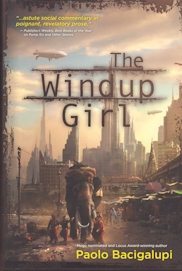
cover of The Windup GirlThe biggest problem with this year's best novel category is that there is only one rocket to go around. I like to see the Hugo Award go to a novel that is unique and memorable and thought-provoking and superbly written. Three of this year's nominees, the Bacigalupi, MiƩville, and Valente novels, meet those criteria for me.

Out of a very strong field, my #1 choice is The Windup Girl by Paolo Bacigalupi. Bacigalupi is only the third author of the past 25 years to see his first novel nominated for both the Hugo and Nebula Awards, and The Windup Girl is just the sort of once-in-a-generation reading experience that suggests. The novel combines an absorbing story with one of the most fascinating settings I've ever encountered, Bacigalupi's vision of future Thailand. Paolo Bacigalupi will be one of the leading voices of the SF field (and all of literature) for as long as he wants to be. A Hugo Award would be a great way to urge him on to a very long writing career.

China MiƩville's The City and the City also features a tremendously inventive setting, the coexisting cities of Beszel and Ul Qoma. The way the inhabitants of both cities learn to unsee one another is fascinating and a powerful metaphor for how people manage to train themselves to avoid facing what is right in front of them. I enjoyed this novel throughout, even though the murder mystery plot is not entirely successful.

Catherynne M. Valente writes in a lush, ornate style that I would detest, except that she does it so exceedingly well. Palimpsest is a beautifully written novel, with striking imagery and a great deal to say about love and sex and the barriers that separate all of us. Valente is one of the very best authors in our field, and I am delighted Palimpsest received a Hugo nomination.

For me, whether I enjoy Robert J. Sawyer's work usually turns on if the ideas of a particular book are interesting enough to overcome the clunky writing. The ideas in WWW: Wake, including a blind woman gaining sight as she encounters an emerging intelligence existing in the Internet, would be strong enough to pass that test but they didn't have to, for I didn't find the writing of WWW: Wake clunky at all. In particular, I would not have thought Sawyer up to the challenge of conveying what it might be like for a blind person to gain eyesight for the first time, yet I found those passages in this novel very powerful and moving. Still, Sawyer can't quite compete with Paolo and China and Cat.

I enjoyed Cherie Priest's Boneshaker, a steampunk zombie adventure that has a lot more going for it than that gimmicky hook might suggest. As described in more detail in my review, Boneshaker is most entertaining, even if not tightly written, but does not compare favorably with the other outstanding works in this category. The same is true for me of Robert Charles Wilson's Julian Comstock, about which I will say nothing more, because I must confess the novel didn't catch my interest enough for me to finish reading it.

With the range and quality of works on this ballot, this is an exciting time to be a science fiction and fantasy reader. I wish I were down under right now, to see one of these outstanding authors receive his or her well-earned recognition.

Aaron's Ballot for Best Novel
1. Paolo Bacigalupi - The Windup Girl
2. China MiƩville - The City and the City
3. Catherynne M. Valente - Palimpsest
4. Robert J. Sawyer - WWW: Wake
5. Cherie Priest - Boneshaker
6. Robert Charles Wilson - Julian Comstock

Wednesday, March 03, 2010

Aaron's Hugo Recommendations :: Best Novel

If I had to submit my Hugo nominations today, these are the novels I would nominate (in alphabetical order by author):

Daniel Abraham, The Price of Spring
Paolo Bacigalupi, The Windup Girl
China MiƩville, The City and the City
Ken Scholes, Lamentation
Catherynne M. Valente, Palimpsest

I fully expect the Bacigalupi and MiƩville novels to make the final ballot, and I would love to see any of the others recognized as well.

Obviously, there are many great novels from 2009 I have not yet read. Given what I know of the authors and what I've heard about the books, these are the five I suspect have the best chance of moving into my list, in the unlikely event I am able to read them in the next ten days:

Daryl Gregory, The Devil's Alphabet
Malinda Lo, Ash
Adam Roberts, Yellow Blue Tibia
Jeff VanderMeer, Finch
Walter Jon Williams, This Is Not a Game

I will update if my list changes before the 13th.

Wednesday, October 15, 2008

Aaron's Story Recommendation of the Week :: The Gambler by Paolo Bacigalupi

Fast Forward 2My story recommendation for this week is "The Gambler," a novelette by Paolo Bacigalupi. Paolo is the first author to garner two of my weekly story recommendations, which is fitting, since in my view no one today is writing better short fiction. (I suspect the two novels he has been working on are great as well, but he hasn't shared them yet.)

You can find "The Gambler" in Fast Forward 2, edited by Lou Anders (cover art by John Picacio). Just out from Pyr Books, Fast Forward 2 contains fourteen tales by some of the leading names in science fiction today, including Ian McDonald, Cory Doctorow, Mike Resnick, and Nancy Kress. As I wrote in my review of Fast Forward 1, the resurgence of the unthemed original anthology series is very encouraging for the SF/F field, in light of the major magazines' declining circulations. In addition to the Fast Forward series, there is strong work in the Eclipse anthologies edited by Jonathan Strahan and in the ongoing The Solaris Book(s) of New Science Fiction edited by George Mann. But Fast Forward is the best of the lot, in no small part because it has Paolo Bacigalupi.

Paolo's work is often praised for taking an unblinking look at important social and political issues. This is true, but it understates what he achieves in his fiction. First and foremost, Paolo writes beautifully crafted stories. He gets you to care about his characters and what happens to them. That is why his stories' messages are effective.

"The Gambler" is set in a near-future newsroom, when reporting is dominated by the ever-present need to draw net traffic, depicted in a great graphic representation called the "maelstrom." Our main character Ong, a political refugee from Laos, wants to investigate serious issues, but there is little room for such stories alongside the latest celebrity sex scandal. This is meaningful social commentary cleverly presented, but what makes the story work is that Bacigalupi gets you into Ong's skin early on:
Sometimes, when I wake in the night to the swish and honk of Los Angeles traffic, the confusing polyglot of dozens of countries and cultures all pressed together, in the American melting pot, I stand at my window and look down a boulevard full of red lights, where it is not safe to walk alone at night, and yet everyone obeys the traffic signals. I look down on the brash and noisy Americans in their many hues, and remember my parents: my father who cared too much to let me live under the self-declared monarchy, and my mother who would not let me die as a consequence. I lean against the window and cry with relief and loss.

Every week I go to temple and pray for them, light incense and make a triple bow to Buddha, Damma, and Sangha, and pray that they may have a good rebirth, and then I step into the light and noise and vibrancy of America.
It is not Ong's parents who need a good rebirth. Soon Ong will receive a huge career break. Whether he can take advantage of it makes for a terrific story, because you care about his fate.

All of which is not meant to minimize the importance of the issues Bacigalupi addresses in his fiction. Indeed, one reading of "The Gambler" is that Ong is a stand-in for Paolo himself, who no doubt has also been told that "no one wants to read about how the world's going to shit." Paolo writes about the world going to shit, but believe me, you want to read it.

Saturday, September 20, 2008

Aaron's Story Recommendation of the Week :: Pump Six by Paolo Bacigalupi

Fantasy & Science Fiction September 2008My story recommendation for this week is "Pump Six" by Paolo Bacigalupi, a novelette from the September 2008 issue of Fantasy & Science Fiction. I already praised "Pump Six" in my review of Pump Six and Other Stories, but F&SF reprinting the story gives me an excuse to talk about it again, and this story deserves all the exposure it can get.

"Pump Six" is set in a near-future New York City in obvious decline. Infrastructure is falling apart, sterility is a rampant problem, and many of the children who are born turn out to be bizarre mutations. Yet New Yorkers seem absurdly unconcerned about all this. The main character is trying to keep the city's sewage plant operating, but he can't even convince his coworkers that wearing a smiley-face sticker does not protect them from the effects of polluted water. Bacigalupi eventually gives us a science fictional explanation for why people are behaving so stupidly. "Pump Six" is by far Bacigalupi's funniest story to date, but it is also just as effective a cautionary SF tale as most of his work.

Paolo Bacigalupi has only published eleven stories, but they are as strong a body of work as anyone in the field has produced in the last decade. (His twelfth story, "The Gambler," to appear in the forthcoming collection Fast Forward 2 edited by Lou Anders, is also excellent.) His stories are always beautifully written and usually address issues important to our collective future. Bacigalupi has been nominated for the Hugo Award three times, and I suggest "Pump Six" merits a fourth nomination.

Thursday, February 28, 2008

Fantastic Reviews :: interview with Paolo Bacigalupi

New on Fantastic Reviews is Aaron's in-depth interview with Colorado author Paolo Bacigalupi.

Paolo Bacigalupi is a new author, but his powerful short fiction has quickly established him as a rising star of science fiction. His stories "The People of Sand and Slag", "The Calorie Man" and "Yellow Card Man" were nominees for the Hugo Award between 2005 and 2007. "The Calorie Man" won the 2006 Theodore Sturgeon Memorial Award, and "The Fluted Girl" was on the shortlist for that award in 2004. Paolo's first book, Pump Six and Other Stories, is just out from Night Shade Books. It collects all of his short fiction to date, plus the original title story.

To read the interview -> Fantastic Reviews author interview with Paolo Bacigalupi